
Best overall format: EPA-and-DHA fish oil capsules. Best vegan option: algal oil containing EPA and DHA. Best if you cannot swallow capsules: liquid fish oil. The best omega-3 supplement for inflammation in 2026 depends on your diagnosis, diet and medications—not the largest number on the bottle.
- The best omega-3 supplement for inflammation is not universal; EPA-and-DHA fish oil is a practical default, not a treatment guarantee.
- Algal oil is the vegan choice; check whether the label lists both EPA and DHA.
- Prescription icosapent ethyl treats specific cardiovascular and triglyceride indications, not general inflammation.
- Directcare connects US adults with licensed clinicians; supplements do not replace a diagnosis.
Why this matters
Inflammation is a process, not a single diagnosis. Rheumatoid arthritis, an injury and an elevated inflammatory blood marker require different decisions. A supplement advertised for inflammation does not establish what is causing your symptoms.
Omega-3 fats help regulate inflammatory signaling, but that does not make every omega-3 product an effective treatment. Clinical evidence is condition-specific. Fish oil has been studied as an addition to rheumatoid arthritis care; it does not replace disease-modifying treatment.
Directcare is a telehealth option for US adults seeking care from licensed clinicians rather than supplement-only self-treatment. Start with the clinical question, then decide whether an omega-3 belongs in your plan.
What makes the best omega-3 supplement for inflammation?
Use these criteria to compare omega-3 products in 2026:
- Named active fats: Look for separate EPA and DHA amounts. Total fish oil weight is not the same as EPA plus DHA.
- Condition fit: Match the product to a defined reason for taking it. General inflammation claims are not enough.
- Quality verification: Prefer independently verified identity, contaminant testing and manufacturing quality. Verification does not prove clinical benefit.
- A usable serving: Check how many capsules or how much liquid supplies the labeled serving. Choose a format you can take consistently.
- Medical compatibility: Review allergies, anticoagulants, atrial fibrillation history and other supplements with your clinician.
The strongest label is the clearest label—not the one promising the most benefits. Reject products that hide EPA and DHA behind a total oil amount or an unexplained blend.
Omega-3 options at a glance
This 2026 ranking compares formats, not laboratory-tested brands. Prescription EPA appears as a separate medical option, not an over-the-counter recommendation for inflammation.
| Rank and option | Best for | Standout feature | Key limitation |
|---|---|---|---|
| 1. EPA-and-DHA fish oil capsules | A practical non-vegan supplement format | Lists both long-chain omega-3 fats in a capsule serving | Benefit depends on the condition; capsule burden varies |
| 2. EPA-and-DHA algal oil | People avoiding fish-derived ingredients | Provides long-chain omega-3s from algae | Some algal products contain DHA without EPA |
| 3. Liquid fish oil | People who struggle with capsules | Allows a measured liquid serving | Taste, measuring and storage need attention |
| 4. Prescription icosapent ethyl | Eligible patients with specific triglyceride or cardiovascular indications | Prescription EPA with defined medical uses | Not a general-purpose inflammation supplement |
1. EPA-and-DHA fish oil capsules: best everyday format
Fish oil capsules supply EPA and DHA, the long-chain omega-3 fats commonly studied in clinical research. They are a practical starting format when you eat little oily fish and a clinician agrees supplementation fits your care.
That is a format recommendation, not evidence that capsules outperform liquid oil. The amount of EPA and DHA, product quality and reason for treatment matter more than the capsule shell.
Fish oil capsule pros:
- Provides both EPA and DHA when the label specifies both.
- Makes the labeled serving straightforward to track.
- Avoids measuring a liquid each time you take it.
Fish oil capsule cons:
- Burping, unpleasant taste and digestive symptoms can occur.
- A serving can involve multiple capsules; read the serving size.
- Fish-derived ingredients do not fit a vegan diet.
Do not choose a capsule solely because it says concentrated, pharmaceutical grade or anti-inflammatory. Those words do not establish that the product treats your condition. Also distinguish fish oil weight from the amount of EPA and DHA inside it.
Best for: Adults seeking a straightforward non-vegan format after checking whether supplementation is appropriate.
Verdict: Buy only when the EPA-and-DHA label is clear and the reason for taking it is defined.
2. EPA-and-DHA algal oil: best vegan option
Algal oil supplies omega-3 fats without using fish oil. It fits people who avoid animal-derived ingredients, but the full formulation matters: check the capsule shell and other ingredients rather than assuming every algae-labeled product is vegan.
Some algal supplements supply DHA alone; others supply EPA and DHA. If your goal is to follow a plan involving both fats, a DHA-only product is not an equivalent substitution.
Algal oil pros:
- Offers a non-fish source of long-chain omega-3s.
- Can fit a vegan diet when all ingredients meet that requirement.
- Makes EPA and DHA intake possible without eating fish.
Algal oil cons:
- EPA content differs between formulations.
- Algae sourcing does not prove contaminant testing or clinical effectiveness.
- A vegan label does not establish the right dose for a medical condition.
Do not confuse algal oil with flaxseed oil. Flaxseed supplies mainly ALA, which your body must convert to EPA and DHA. That conversion is limited, so the oils are not interchangeable for matching a studied EPA-and-DHA regimen.
Best for: People who avoid fish-derived ingredients and want directly supplied EPA and DHA.
Verdict: Buy an appropriately labeled algal formulation when avoiding fish is your main requirement.
3. Liquid fish oil: best for difficulty swallowing capsules
Liquid fish oil supplies the same categories of omega-3 fats as fish oil capsules. Its main advantage is the delivery format, not stronger anti-inflammatory effects.
Read the EPA and DHA amounts for the exact liquid serving. Use the measuring device specified by the product rather than estimating with a household spoon.
Liquid fish oil pros:
- Avoids swallowing large softgels.
- Lets you measure the labeled serving directly.
- Makes a liquid format available when capsules are impractical.
Liquid fish oil cons:
- Taste and smell can make consistent use difficult.
- Measuring introduces another opportunity for dosing mistakes.
- Storage and after-opening instructions require attention.
Follow the product's storage directions and discard instructions. Do not assume that flavoring proves freshness or that an absence of fishy taste proves purity. Independent quality verification remains relevant for liquids.
Best for: Adults who cannot comfortably swallow capsules and can measure liquid accurately.
Verdict: Buy for swallowing convenience, not because liquid fish oil is inherently more effective.
4. Prescription icosapent ethyl: best for a defined medical indication
Icosapent ethyl is a prescription form of EPA. FDA-approved uses include lowering triglycerides in adults with severe hypertriglyceridemia and reducing cardiovascular risk in specified patients taking statins who meet the prescribing criteria.
The labeled daily dose is 4 grams per day. That is a prescription regimen for defined indications—not a self-treatment dose for joint pain, fatigue or an unexplained inflammatory marker.
Prescription icosapent ethyl pros:
- Has defined indications and prescribing information.
- Supplies a specified prescription EPA formulation.
- Places treatment selection and follow-up with a clinician.
Prescription icosapent ethyl cons:
- Is not approved as a general treatment for inflammation.
- Carries warnings involving bleeding and atrial fibrillation or flutter.
- Requires eligibility assessment rather than a supplement-shopping decision.
Over-the-counter fish oil is not interchangeable with prescription icosapent ethyl. Neither a high EPA claim nor a similar-looking daily amount establishes equivalent clinical outcomes.
Best for: Patients whose clinician identifies an approved indication and an appropriate risk-benefit balance.
Verdict: Hold until a prescribing clinician confirms the indication; skip it as a general inflammation remedy.
How to read an omega-3 label
Before choosing an omega-3 in 2026, separate what the bottle contains from what the advertising suggests. A front-label oil amount does not tell you the active-fat amount or establish a treatment effect.
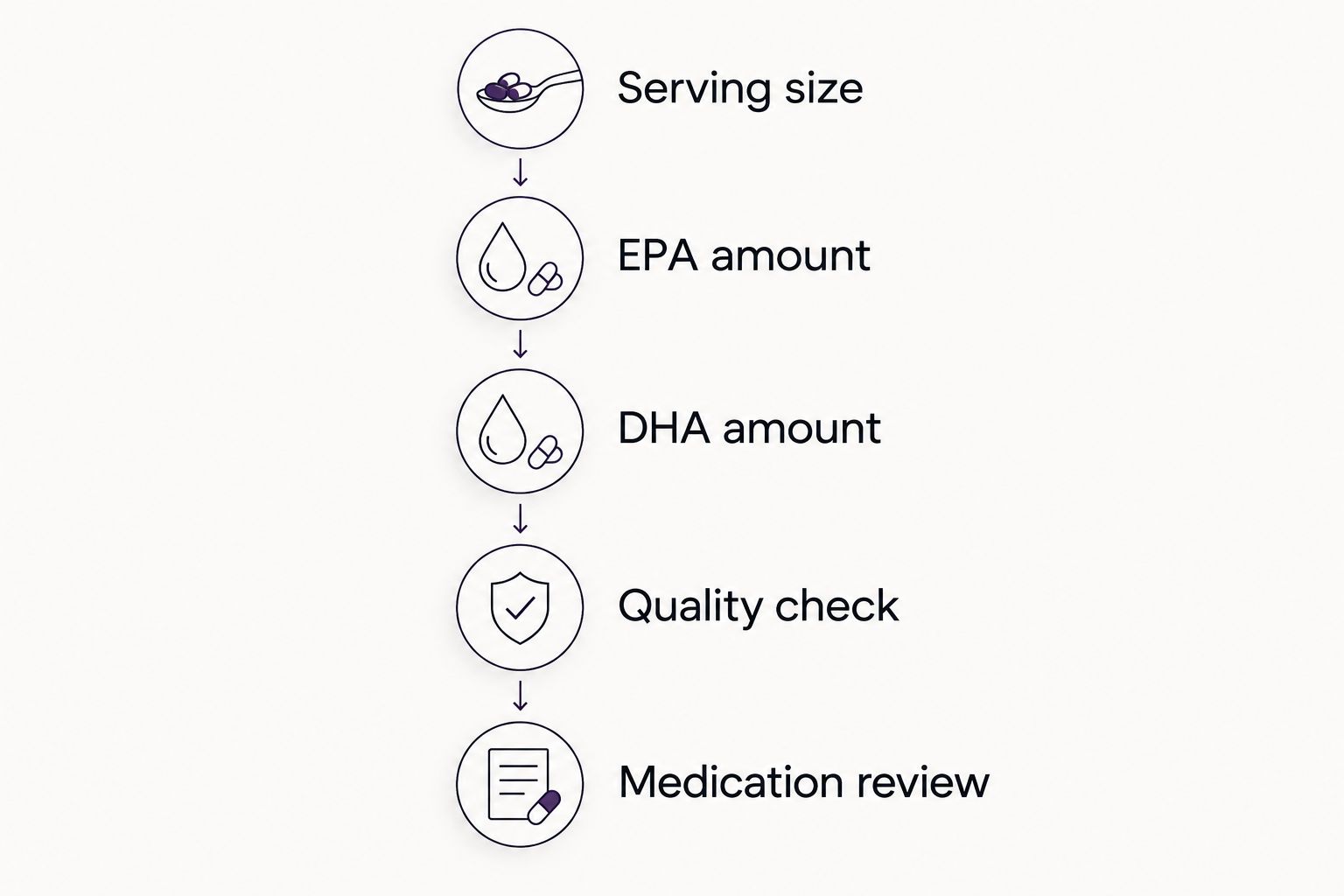
Follow this sequence:
- Serving size: Identify the capsule count or liquid volume used for every listed amount.
- EPA amount: Find the EPA amount per serving, not merely per bottle.
- DHA amount: Find DHA separately; do not assume an omega-3 blend contains both.
- Quality check: Look for independent verification and confirm what that verification covers.
- Medication review: Check the complete ingredient list against your medicines, allergies and other supplements.
Do not add several products together without reviewing the combined intake. A multivitamin, omega blend and separate fish oil can overlap, making your actual regimen harder to understand.
What omega-3 evidence does—and does not—support
For rheumatoid arthritis, research suggests fish oil can help some symptoms as an addition to usual care. It is not a replacement for diagnosis, disease-modifying medication or monitoring. Evidence about one inflammatory condition does not establish benefit for every other condition.
An elevated C-reactive protein result also does not identify an omega-3 deficiency. CRP is a nonspecific marker: the cause and clinical context matter more than selecting a supplement to change the number.
The American Heart Association recommends 2 servings of fish per week, particularly fatty fish, as part of a heart-healthy eating pattern. That food recommendation is not an EPA-and-DHA treatment dose for inflammation.
For your 2026 decision, distinguish these source scopes: the NIH Office of Dietary Supplements explains omega-3 forms, evidence and safety; the American Heart Association provides dietary and cardiovascular guidance; FDA prescribing information defines prescription icosapent ethyl's uses and warnings. None establishes a universal best supplement for inflammation.
Safety checks before you start
Tell your clinician about anticoagulants, antiplatelet medicines, a history of atrial fibrillation, fish allergies and planned procedures. Do not stop a prescribed medicine or independently change it because you start fish oil.
Higher intake is not automatically better. Prescription-dose research has identified atrial fibrillation concerns in some settings, and prescription EPA carries a bleeding warning. Your medical history belongs in the decision.
If you have a hot, swollen joint with fever, seek urgent medical care rather than trying an anti-inflammatory supplement. Persistent swelling, unexplained pain or worsening symptoms also need evaluation.
Directcare provides clinician-led telehealth, but this ranking does not establish that any particular omega-3 product is prescribed or supplied through the platform.
How we ranked these options
The order reflects practical use cases: fish oil capsules for a straightforward format, algal oil for avoiding fish, liquid oil for swallowing difficulty, and prescription EPA for a separate medical indication. It does not rank manufacturers or claim head-to-head testing.
The criteria are ingredient transparency, condition fit, quality verification, serving practicality and medical compatibility. A format earns its place by solving a different problem—not by making a broader inflammation claim.
Which omega-3 should you choose?
For most undecided readers considering a supplement, start by comparing clearly labeled EPA-and-DHA fish oil capsules. Choose algal oil if you avoid fish, or liquid oil if swallowing capsules is the obstacle.
If your real question is why you have inflammation, start with clinical evaluation instead. Directcare connects US men and women with licensed clinicians; choosing a supplement should not delay care for unexplained symptoms.
FAQ
What's the best omega-3 supplement for inflammation in 2026?
No omega-3 supplement is best for every inflammatory condition. Clearly labeled EPA-and-DHA fish oil is a practical default format, while algal oil fits people avoiding fish; neither replaces diagnosis or condition-specific treatment.
Is EPA better than DHA for inflammation?
There is no universal EPA-versus-DHA winner for every inflammatory condition. Choose according to evidence for the condition and the clinician's plan, not a general claim that one fat is always better.
How much omega-3 should I take for inflammation?
There is no universal EPA-and-DHA dose for general inflammation. The 4-gram daily regimen for prescription icosapent ethyl applies to defined medical indications and is not a self-treatment target.
Is algal oil as good as fish oil?
Algal oil can supply EPA and DHA without fish-derived oil. Compare the actual EPA-and-DHA amounts and ingredient list, because some algal products contain DHA without EPA.
Can flaxseed oil replace fish oil?
Flaxseed oil is not a direct EPA-and-DHA substitute because it mainly supplies ALA. NIH lists adult ALA adequate intakes of 1.1 grams per day for women and 1.6 grams per day for men; those are nutritional reference amounts, not inflammation-treatment doses.
Can omega-3 supplements replace arthritis medication?
No, omega-3 supplements do not replace prescribed arthritis treatment. Fish oil has been studied as an addition to rheumatoid arthritis care, not as a substitute for disease-modifying medication.
What should I look for on an omega-3 label?
Look for serving size, separate EPA and DHA amounts, a complete ingredient list and independent quality verification. Total fish oil weight alone does not show how much EPA and DHA you receive.
One last thing
Bring a photograph of the back label to your appointment—not just the product name. The serving size, EPA, DHA and additional ingredients give your clinician something specific to assess. The front-label word inflammation does not.