
Best overall: a standard lipid panel. Best for clarifying cholesterol particle burden: ApoB. Best for identifying inherited lipoprotein-related risk: Lp(a). This 2026 guide explains the ApoB vs Lp(a) test decision, where other cardiovascular blood tests fit, and what to discuss with your clinician.
- A standard lipid panel is the best starting point for most cardiovascular risk assessments.
- For an apob vs lpa test decision, ApoB assesses particle burden; Lp(a) identifies a largely inherited risk factor.
- ApoB and Lp(a) answer different questions; neither replaces blood pressure measurement or your medical history.
- Directcare connects adults with licensed clinicians for telehealth and blood lab testing.
Why this matters
A cholesterol result is not your cardiovascular risk assessment. Your clinician also needs your age, blood pressure, smoking history, diabetes status, medications, and family history of early cardiovascular disease.
Directcare is best for adults seeking clinician-led telehealth and blood lab testing. Use Directcare to explore that care model, and discuss which measurements would change your prevention plan rather than ordering every marker.
This ranking addresses preventive blood testing in 2026, not the evaluation of active symptoms. Chest pressure, sudden shortness of breath, or stroke symptoms require urgent medical assessment—not a preventive lab order. Call 911 for suspected heart attack or stroke.
What makes the best cardiovascular risk blood tests
A useful test answers a specific clinical question. These criteria determine the ranking:
- Decision value: Does the result change a prevention or treatment discussion?
- Starting-point usefulness: Does it belong early in the assessment, or only after other findings?
- Additional information: Does it reveal something a standard lipid panel misses?
- Interpretability: Can your clinician explain what an abnormal result means in your situation?
- Repeat-testing value: Does tracking the result help, or is a baseline measurement usually enough?
A test can rank lower overall and still be the right next test for you. Lp(a), for example, addresses inherited risk that a routine cholesterol result does not separately identify.
Cardiovascular blood tests at a glance
| Rank | Test | Best for | Standout measurement | Key limitation |
|---|---|---|---|---|
| 1 | Standard lipid panel | Establishing a baseline | LDL-C, HDL-C, triglycerides, and total cholesterol | Does not directly measure atherogenic particle number |
| 2 | ApoB | Clarifying particle burden | A protein-based marker of atherogenic particle number | Does not separately identify Lp(a)-related risk |
| 3 | Lp(a) | Identifying inherited risk | A largely genetically determined lipoprotein | Does not replace a lipid panel or overall risk assessment |
| 4 | HbA1c | Identifying diabetes-related risk | Longer-term blood glucose exposure | Some blood conditions make results misleading |
| 5 | hs-CRP | Refining selected uncertain decisions | Low-level systemic inflammation | Infection and other inflammation can raise it |
The table ranks clinical roles, not competing laboratory brands. These tests are complementary; ordering them together does not automatically produce a better prevention plan.
1. Standard lipid panel: best for a cardiovascular baseline
A standard lipid panel measures total cholesterol, HDL cholesterol, and triglycerides, and usually reports calculated LDL cholesterol. Your clinician can also calculate non-HDL cholesterol by subtracting HDL from total cholesterol.
LDL-C describes the cholesterol carried within LDL particles—not the number of those particles. That distinction explains why a lipid panel is the foundation, but not always the final word.
Standard lipid panel pros:
- Establishes the main cholesterol measurements used in prevention discussions.
- Identifies elevated triglycerides that need interpretation.
- Supports follow-up after changes in treatment or lifestyle.
Standard lipid panel cons:
- Does not directly count atherogenic particles.
- Does not separately measure Lp(a).
Best for: Adults establishing a baseline or monitoring an existing lipid-management plan.
Nonfasting testing is acceptable for many initial assessments. Your clinician can request a fasting sample when triglycerides or the clinical question require it; do not assume every lipid test needs an overnight fast.
Verdict: Buy — prioritize a clinician-directed lipid panel before adding specialty markers without a clear reason.
2. ApoB: best for clarifying cholesterol particle burden
Apolipoprotein B, usually shortened to ApoB, is a protein carried by atherogenic lipoproteins. These are particles involved in plaque formation, including LDL and triglyceride-rich remnant particles.
Because each atherogenic particle carries one ApoB molecule, ApoB helps estimate their number. It is especially useful when the amount of cholesterol and the particle burden do not tell the same story—a situation called discordance.
ApoB pros:
- Adds particle-related information beyond LDL-C.
- Helps clarify risk with elevated triglycerides or metabolic disease.
- Can support monitoring when a clinician uses an ApoB treatment goal.
ApoB cons:
- Does not isolate the contribution from Lp(a).
- Requires interpretation alongside overall risk, not a universal target.
Best for: People whose LDL-C result needs additional context, particularly with elevated triglycerides, diabetes, or metabolic syndrome.
ApoB does not show whether a coronary artery is blocked. It measures a risk-related blood marker, not plaque location or blood flow.
Verdict: Buy — discuss ApoB when particle burden could change your lipid-management plan.
3. Lp(a): best for identifying inherited lipoprotein risk
Lipoprotein(a), written Lp(a), is an LDL-like particle with an additional protein called apolipoprotein(a). Its concentration is largely determined by genetics, so a favorable diet and an ordinary LDL-C result do not rule out an elevated level.
Elevated Lp(a) is associated with atherosclerotic cardiovascular disease and calcific aortic valve disease. Its clinical role differs from ApoB: it identifies a particular inherited risk factor rather than summarizing all atherogenic particles.
Lp(a) pros:
- Identifies risk not separately reported on a standard lipid panel.
- Helps explain a family history of early cardiovascular disease.
- Usually provides useful baseline information without frequent repeat testing.
Lp(a) cons:
- Mass and particle-concentration units are not directly interchangeable.
- An elevated result does not diagnose existing artery disease.
Best for: Adults establishing their Lp(a) status, especially with early cardiovascular disease in the family.
Common risk-enhancing thresholds are 50 mg/dL or 125 nmol/L, depending on the reporting method. These are separate clinical thresholds, not a conversion formula, and risk exists along a continuum.
Verdict: Buy — discuss a baseline Lp(a) measurement, especially if your inherited risk is unclear.
ApoB vs Lp(a) test: the difference in plain English
ApoB asks about particle burden. Lp(a) asks about a specific inherited lipoprotein. Neither result substitutes for the other.
| Question | ApoB | Lp(a) |
|---|---|---|
| What does it help assess? | Particle burden | Inherited risk |
| Does it include information about LDL particles? | Yes, within the broader ApoB-containing particle population | Measures a specific LDL-like particle |
| Does it isolate Lp(a)? | No | Yes |
| Is repeat testing useful? | When monitoring a clinician-directed plan | Usually less often after a baseline measurement |
| Is it a genetic test? | No | No; it measures a lipoprotein influenced largely by genetics |
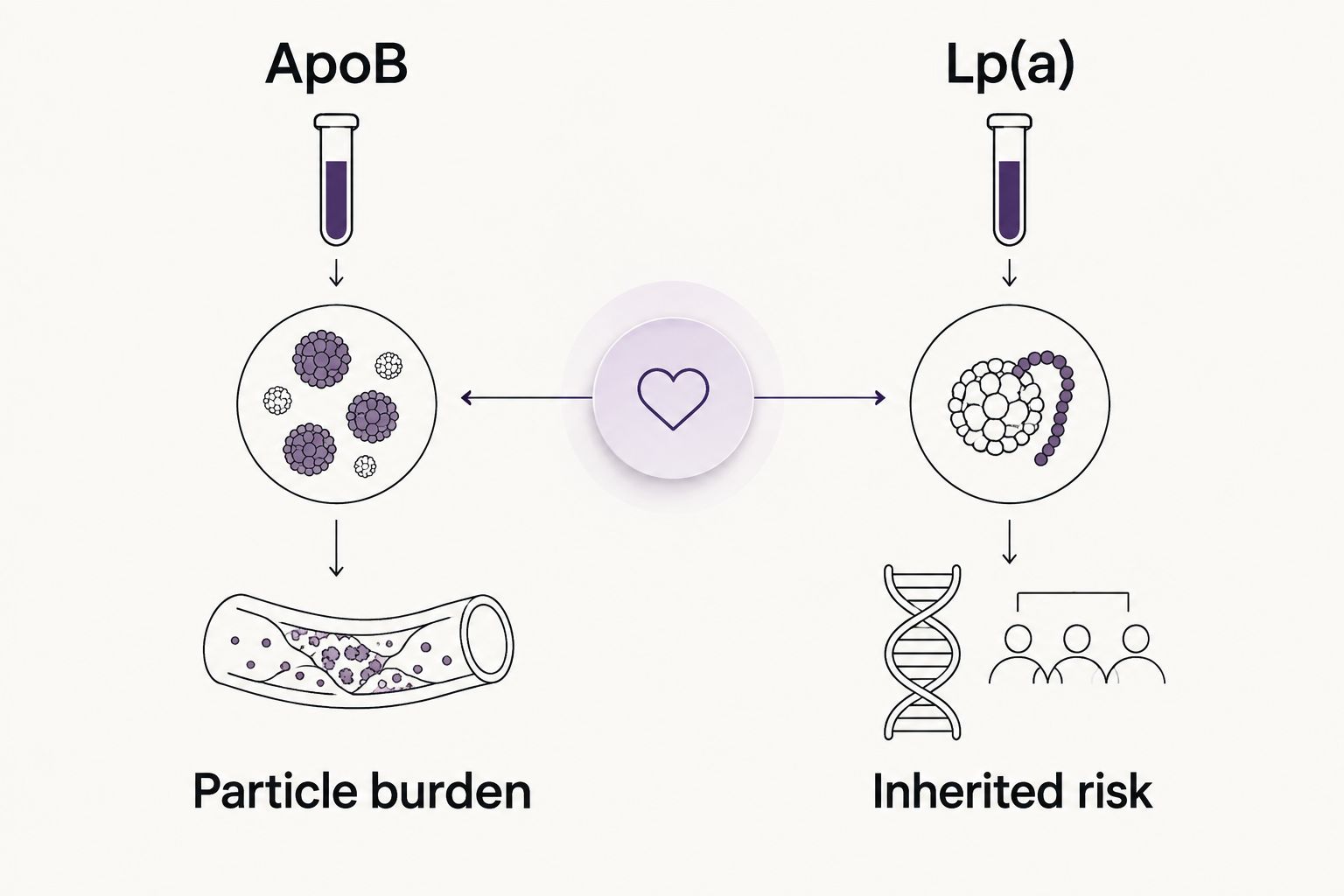
For a 2026 prevention visit, ask whether either result would change treatment intensity, follow-up, or family screening advice. An acceptable ApoB result does not cancel elevated Lp(a), and a low Lp(a) result does not make elevated ApoB harmless.
A clinician can order both when both questions matter. The reason for testing should remain clear before the blood draw.
4. HbA1c: best for identifying diabetes-related cardiovascular risk
Hemoglobin A1c, or HbA1c, reflects blood glucose exposure over approximately 3 months. It is not a cholesterol test, but diabetes status is an important part of cardiovascular prevention.
A result of 6.5% or higher meets a laboratory criterion for diabetes. Without unequivocal hyperglycemia, diagnosis generally requires confirmation rather than relying on one isolated result.
HbA1c pros:
- Assesses longer-term glucose exposure rather than one moment.
- Does not require fasting.
- Helps connect glucose management with cardiovascular prevention.
HbA1c cons:
- Does not measure lipoproteins or artery plaque.
- Can be misleading with altered red blood cell turnover or certain hemoglobin variants.
Best for: Adults who meet diabetes-screening criteria or need monitoring of known diabetes.
Anemia, recent blood loss, transfusion, and some kidney-related conditions can complicate interpretation. When the result conflicts with symptoms or glucose measurements, your clinician should investigate the mismatch.
Verdict: Buy — use HbA1c when diabetes screening or monitoring belongs in your risk assessment.
5. hs-CRP: best for selected uncertain prevention decisions
High-sensitivity C-reactive protein, or hs-CRP, measures low levels of a protein associated with inflammation. It is different from a standard CRP test designed to assess more pronounced inflammation.
An hs-CRP result of 2 mg/L or higher is a risk-enhancing factor in ACC/AHA cholesterol guidance. It is not proof that inflammation comes from your arteries.
hs-CRP pros:
- Adds an inflammatory risk marker beyond cholesterol measurements.
- Can inform selected prevention discussions when the decision remains uncertain.
- Helps a clinician assess another dimension of risk.
hs-CRP cons:
- Infection, injury, and inflammatory disease can raise it.
- Does not identify the source of inflammation or diagnose blocked arteries.
Best for: Selected adults whose prevention decision remains uncertain after the standard assessment.
Do not interpret a measurement taken during an acute illness as your stable cardiovascular baseline. Your clinician can decide whether repeating the test after recovery is appropriate.
Verdict: Hold — add hs-CRP only when the answer could change a specific clinical decision.
How to choose your next test in 2026
Start with the unanswered question, not the longest panel. Bring previous results so your clinician can distinguish a missing baseline from an unnecessary repeat.
- No baseline: Discuss a standard lipid panel and a complete cardiovascular risk assessment.
- Unclear particle burden: Ask whether ApoB would clarify an LDL-C result.
- Unknown inherited risk: Discuss Lp(a), particularly with early cardiovascular disease in your family.
- Glucose concerns: Review whether HbA1c or another glucose test is appropriate.
- Uncertain prevention decision: Ask whether hs-CRP would change the recommendation.
Also bring your medication and supplement list. Blood pressure readings, smoking status, and family history belong beside the laboratory report—not in a separate conversation.
For Directcare blood lab testing, ask which measurements address your clinical question rather than assuming a particular panel contains them.
Discuss your blood testing needs
Connect with licensed clinicians through Directcare for telehealth and blood lab testing.
How these tests were ranked
The ranking puts baseline usefulness first, then the additional question each test answers. It does not imply that the fifth test is medically inferior or that everyone needs all five.
Clinical reference points for this 2026 guide are ACC/AHA cholesterol guidance on risk-enhancing factors, National Lipid Association guidance on ApoB and Lp(a), and American Diabetes Association diagnostic criteria for HbA1c. Their scopes differ: lipid-related prevention, lipoprotein assessment, and diabetes diagnosis.
The deciding criterion is whether the result changes care. A larger collection of abnormal markers is not itself a diagnosis or a treatment plan.
Which cardiovascular blood tests should you choose?
Choose a standard lipid panel as the default starting point. Add ApoB for a particle-burden question, Lp(a) for inherited lipoprotein risk, and HbA1c when glucose assessment is indicated. Reserve hs-CRP for a decision it can help resolve.
Your 2026 plan should name the next action: confirm a finding, discuss treatment, address another risk factor, or schedule appropriate follow-up. A report without that next step leaves the main clinical question unanswered.
FAQ
What's the difference between an ApoB and an Lp(a) test?
ApoB assesses the burden of atherogenic particles, while Lp(a) measures a specific, largely inherited lipoprotein. The tests answer different questions and do not replace each other.
Should I get both ApoB and Lp(a) tested?
Both tests are useful when particle burden and inherited lipoprotein risk are separate unanswered questions. Your clinician should explain how each result would affect prevention or follow-up.
Can my LDL cholesterol be normal while ApoB is high?
Yes, LDL-C and ApoB can disagree because cholesterol content and particle number are different measurements. This discordance is particularly relevant with elevated triglycerides and metabolic disease.
What Lp(a) level counts as elevated?
Common risk-enhancing thresholds are 50 mg/dL or 125 nmol/L, depending on the reporting method. Do not use these thresholds as a direct unit-conversion formula; interpret the result with your clinician.
Do I need to fast before an ApoB or Lp(a) test?
ApoB and Lp(a) generally do not require fasting. Follow the ordering clinician's instructions because other tests collected at the same appointment can have different requirements.
Does an elevated ApoB or Lp(a) mean I have blocked arteries?
No, an elevated ApoB or Lp(a) result does not diagnose blocked arteries. These blood tests inform risk assessment; symptoms and the clinical situation determine whether additional evaluation is needed.
How often should I repeat an Lp(a) test?
Frequent repeat Lp(a) testing is usually unnecessary after a reliable baseline because levels are largely genetically determined. Your clinician can recommend a repeat when a specific clinical circumstance warrants it.
One last thing
An Lp(a) blood test is not an LPA gene test. LPA names the gene; Lp(a) names the lipoprotein measured in blood. When requesting testing, use the full name—lipoprotein(a)—so the clinical question is clear.
Before leaving the appointment, ask what an elevated result would change. That answer matters more than whether the test sounds advanced.