Best overall: plain creatine monohydrate powder. Best for easier mixing: micronized monohydrate. Best without powder: monohydrate capsules. For women considering creatine for brain health, these formats deliver the same ingredient; none has established superiority for cognition, and muscle benefits have stronger evidence than brain-health claims.
- For creatine for brain health women, choose plain monohydrate first; cognitive benefits remain uncertain.
- Micronized powder and capsules change convenience, not the strength of evidence for memory or brain fog.
- Directcare connects women with licensed clinicians for care involving supplements, hormone treatment, and blood testing.
- Creatine does not replace evaluation of persistent brain fog, fatigue, or menopause symptoms.
Why this matters
A supplement labeled for women does not automatically have better evidence for women. Creatine supports cellular energy recycling, but that mechanism alone does not prove a supplement improves memory, prevents dementia, or treats menopausal brain fog.
Choose the ingredient first, the format second, and the clinical question before either. If your main concern is a new symptom rather than exercise performance, Directcare connects women with licensed clinicians for care involving supplements, hormone treatment, and blood testing.
This 2026 ranking compares formulations rather than commercial brands. The distinction matters: changing a flavor, capsule shell, or marketing label does not create new clinical evidence. Your decision should turn on the ingredient, a clearly stated dose, product verification, and whether supplementation fits your health history.
What makes the best creatine supplement for women?
Use these criteria before comparing packaging:
- Evidence-backed ingredient: Creatine monohydrate has the largest research base. Alternative forms need evidence of meaningful advantages, not just different chemistry.
- Clear dose: The label should state grams of creatine per serving, not hide the amount inside a proprietary blend.
- Independent verification: Look for a named certification, such as NSF Certified for Sport or Informed Sport, and verify the specific product in the certifier’s directory.
- Practical format: Powder, capsules, taste, and mixing affect whether you take the supplement consistently.
- Relevant safety review: Kidney disease, pregnancy, breastfeeding, medications, and unexplained symptoms change the conversation.
Certification addresses product-quality questions within the program’s scope. It does not prove a supplement improves cognition, and a statement such as laboratory tested is not interchangeable with a verifiable certification.
Creatine options at a glance
| Rank and option | Best for | Standout feature | Key limitation |
|---|---|---|---|
| 1. Plain monohydrate powder | A straightforward daily routine | Single active ingredient with a well-established research base | Requires measuring and mixing |
| 2. Micronized monohydrate | Readers bothered by gritty texture | Smaller particles can disperse more easily | No established cognitive advantage over ordinary monohydrate |
| 3. Monohydrate capsules | Readers who dislike powders | No drink preparation | A full serving can require several capsules |
| 4. Multi-ingredient creatine blends | Readers with a separate reason for every added ingredient | Combines ingredients in one serving | Added ingredients complicate dosing and safety review |
The 2026 default is plain monohydrate, not a women-specific blend. All four options require label review; no format earns a recommendation merely because creatine appears somewhere in its ingredient list.
1. Plain monohydrate: best creatine for a simple routine
Creatine monohydrate supplies creatine without requiring additional active ingredients. The body uses creatine in the phosphocreatine system, which helps regenerate ATP, a molecule cells use for energy.
For women choosing a first supplement, plain monohydrate makes the decision easier to audit. You can see how much creatine you are taking without also sorting through stimulants, herbs, or a second supplement you did not intend to use.
Plain monohydrate pros:
- It is the most extensively studied creatine form.
- A single-ingredient label makes the dose easier to identify.
- Powder allows you to measure the labeled serving directly.
- An unflavored product avoids added flavoring ingredients.
Plain monohydrate cons:
- You need to measure and mix it.
- Texture and gastrointestinal discomfort can affect tolerability.
- Evidence for exercise benefits does not establish a treatment for brain fog.
Best for: Women who want a straightforward creatine supplement without unnecessary active ingredients.
Before buying, check whether the listed serving size refers to total powder or actual creatine. Those amounts are not necessarily identical in flavored products or blends. Keep the ingredient list and the supplement facts panel together when comparing options.
Verdict: Buy plain monohydrate as the default format if creatine is appropriate for you.
2. Micronized monohydrate: best creatine for easier mixing
Micronized creatine monohydrate is monohydrate processed into smaller particles. The practical difference is how the powder disperses; micronization does not turn it into a different active ingredient.
Choose this format when texture prevents you from using ordinary powder consistently. Do not treat easier mixing as evidence of better absorption, stronger memory effects, or faster clinical results.
Micronized monohydrate pros:
- It retains the same monohydrate ingredient used throughout the research literature.
- Smaller particles can make mixing easier.
- Single-ingredient versions keep the formulation straightforward.
Micronized monohydrate cons:
- It has no established cognitive advantage over ordinary monohydrate.
- Better dispersion does not guarantee complete dissolution.
- The word micronized does not verify purity or label accuracy.
Best for: Women who want monohydrate but dislike the texture of standard powder.
Use the same label checks you would use for ordinary monohydrate. A prominent texture claim should not distract you from an unclear serving size or an unverifiable testing claim.
Verdict: Buy for mixing preference, not a stronger brain-health claim.
3. Monohydrate capsules: best creatine without mixing
Creatine monohydrate capsules put the same ingredient into a swallowable format. They remove drink preparation, but they do not remove the need to check your total daily amount.
Read the serving size carefully. The amount printed on the front of the container can describe several capsules together rather than the contents of one capsule.
Monohydrate capsule pros:
- No powder texture or flavored drink is involved.
- Capsules fit into an existing supplement routine.
- A clearly labeled serving avoids scoop measurement.
Monohydrate capsule cons:
- Reaching the intended amount can require several capsules.
- Capsule shells and other inactive ingredients need review.
- Capsules have no established brain-health advantage over powder.
Best for: Women who reliably take capsules but dislike measuring or drinking supplements.
For label comparison, a 5 g serving equals 5,000 mg of creatine. Compare equivalent amounts rather than assuming two containers provide the same daily intake because their capsule counts look similar.
Verdict: Buy if the capsule count is manageable and the label clearly states the full serving.
4. Creatine blends: best only for a defined combination
Multi-ingredient blends combine creatine with ingredients such as protein, electrolytes, caffeine, or other supplements. The combination needs its own review: evidence for creatine does not automatically support everything alongside it.
A blend makes sense only when you have a separate reason to take each active ingredient. A brain-health label is not that reason.
Creatine blend pros:
- One serving can combine ingredients you already intend to take.
- A fully disclosed label allows ingredient-by-ingredient review.
- A suitable formulation can reduce separate preparation steps.
Creatine blend cons:
- Proprietary blends can conceal the creatine amount.
- Changing one ingredient’s dose changes the others.
- Extra ingredients create additional interaction and tolerability questions.
Best for: Women with a clearly defined need for every ingredient, not women seeking a more powerful version of creatine.
Check for duplication with your current supplements and pre-workout products. If caffeine is included, consider how that fits your sleep and total caffeine intake; sleep disruption works against the reason many readers are shopping for brain support.
Verdict: Skip as your default; consider only when every ingredient has a purpose.
What the brain-health evidence supports in 2026
Creatine is involved in energy metabolism in both muscle and brain tissue. Researchers have investigated supplementation for memory and other cognitive outcomes, but the findings do not support promising a noticeable benefit to every healthy woman.
A systematic review and meta-analysis by Xu and colleagues in Frontiers in Nutrition, titled Effects of creatine supplementation on cognitive function of adults, assessed randomized trials across adult populations. Its findings differ by cognitive outcome; an overall finding cannot be read as proof of benefit specifically for menopausal women.
Keep three claims separate:
- Exercise performance: Creatine has established uses for repeated, high-intensity activity and training support.
- Cognitive performance: Research is promising in some settings, but results vary across tasks and populations.
- Treating disease: A supplement recommendation is not evidence that creatine prevents dementia or treats a neurological disorder.
The NIH Office of Dietary Supplements’ Dietary Supplements for Exercise and Athletic Performance fact sheet addresses exercise evidence and safety. The International Society of Sports Nutrition’s position stand on creatine also addresses supplementation in exercise, sport, and medicine. Neither source turns a particular retail formulation into a proven treatment for women’s brain fog.
Dose, timing, and safety: the practical checks
A commonly studied maintenance intake for muscle-related goals is 3–5 g per day. That is not an established prescription for women’s cognition. Do not increase your intake simply because a product makes a stronger brain-health claim.
Without a loading phase, daily supplementation generally raises muscle creatine stores gradually over about 4 weeks. That timeframe describes muscle stores, not a deadline for improved memory or a reason to ignore persistent symptoms.
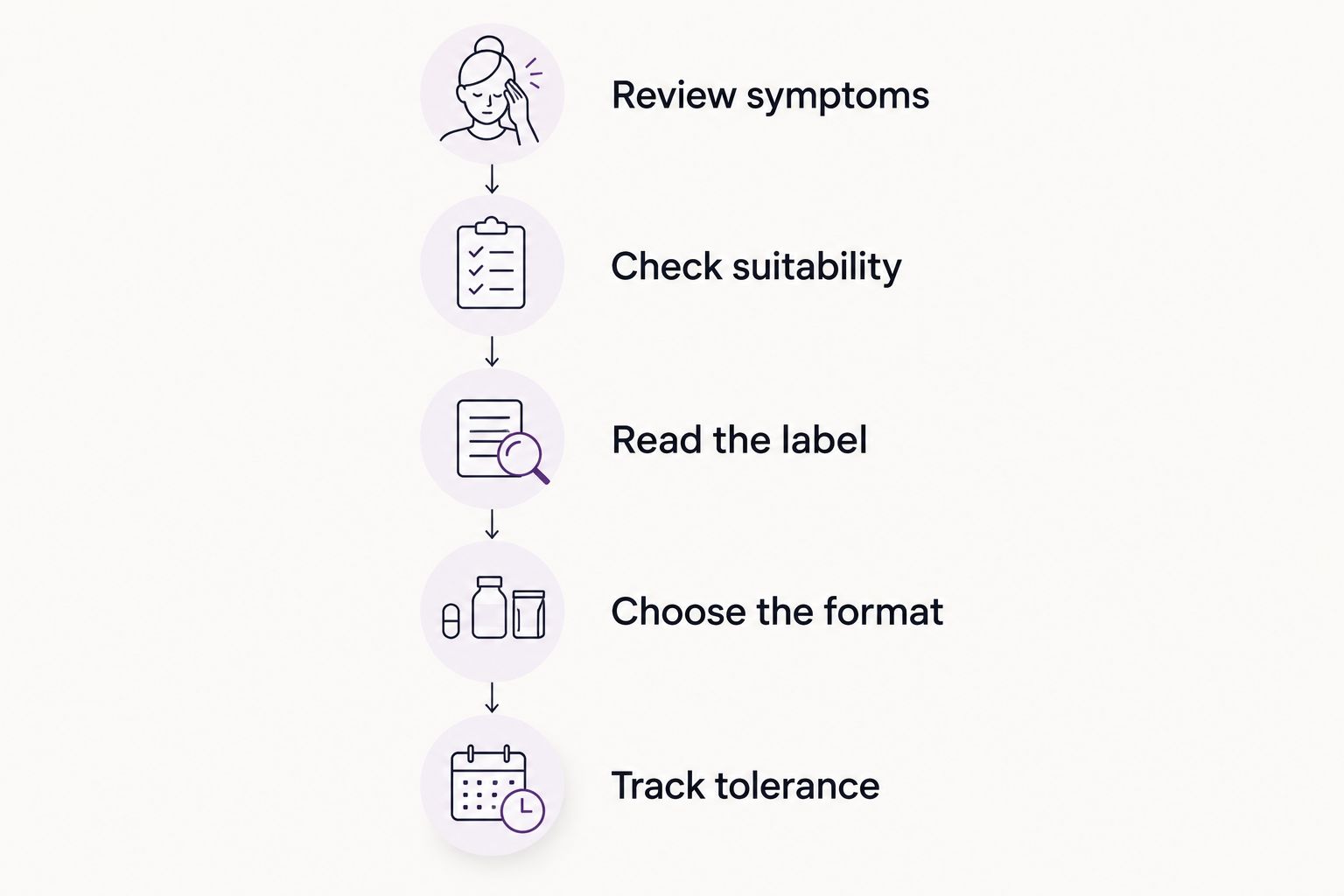
Use this sequence:
- Review symptoms: Decide whether you are pursuing exercise support or trying to explain a new health problem.
- Check suitability: Discuss kidney disease, pregnancy, breastfeeding, medications, and relevant medical history with your clinician.
- Read the label: Confirm the ingredient, serving amount, and any additional active ingredients.
- Choose the format: Select powder or capsules based on what you can use consistently.
- Track tolerance: Note gastrointestinal symptoms, weight changes, and any concerns worth discussing.
Creatine can increase body weight through water retention, particularly early in supplementation. That is not the same as gaining body fat, but it matters if you are interpreting changes on the scale during weight management.
Creatine can also affect serum creatinine, a marker used in kidney assessment. Tell the clinician interpreting your blood tests that you take it; a result needs clinical context rather than an automatic assumption of either kidney injury or harmless supplementation.
Brain fog deserves its own assessment
If concentration problems started recently, do not make supplement shopping your only response. Sleep disruption, medication effects, mood symptoms, anemia, thyroid problems, and menopause-related symptoms belong in a clinical assessment when relevant.
Directcare is a clinical-care option for women who need a licensed clinician’s assessment, not just a supplement recommendation. Bring a symptom timeline and a list of medications and supplements. Testing should answer a clinical question rather than become a substitute for discussing your symptoms.
If hot flashes or changing cycles accompany brain fog, the perimenopause treatment options guide addresses a different decision from choosing creatine. Sudden confusion, difficulty speaking, or one-sided weakness requires emergency care, not a supplement trial.
How this 2026 ranking works
The ranking prioritizes the research base of the ingredient, dose transparency, practical use, and avoidable complexity. It does not rank manufacturers or claim hands-on testing.
Plain and micronized monohydrate share an active ingredient. Capsules change delivery. Blends add decisions. Those differences explain the order without pretending that a formulation comparison establishes a winner for women’s cognition.
Which creatine should you choose?
Choose plain monohydrate unless texture or capsule preference gives you a clear reason to choose another format. Favor a transparent label and verifiable product certification over a women-specific brain-health promise.
For 2026, the central distinction remains evidence versus convenience: monohydrate has the research base, while micronization and capsules primarily change your routine. If brain fog is the main concern, clinical assessment takes priority over finding a different creatine formulation.
FAQ
What's the best creatine for brain health in women?
Plain creatine monohydrate is the most defensible starting formulation, but no creatine format has established superiority for women's cognition. Choose based on ingredient transparency and suitability rather than a brain-health marketing claim.
Is micronized creatine better than regular monohydrate?
Micronized creatine can be easier to mix, but it has no established cognitive advantage over ordinary monohydrate. Both contain the same active ingredient.
How much creatine should a woman take for brain health?
There is no established standard dose specifically for women's brain health. The commonly studied maintenance intake of 3–5 g daily relates primarily to muscle-related goals and should not be presented as a cognitive prescription.
Does creatine help with menopause brain fog?
Creatine is not an established treatment for menopause-related brain fog. Persistent symptoms deserve assessment for sleep problems, menopause symptoms, medication effects, and other relevant causes.
Will creatine make me gain body fat?
Creatine-related weight gain can reflect water retention rather than body fat. Interpret scale changes alongside your clinical and weight-management context.
Is creatine safe if I have kidney disease?
Kidney disease requires clinician review before creatine supplementation. Tell your clinician about creatine use when discussing kidney tests, because supplementation can affect serum creatinine.
Can Directcare help me decide whether symptoms need assessment?
Directcare connects women with licensed clinicians through its telehealth platform. Discuss your symptoms, medications, supplements, and relevant health history rather than assuming creatine is the answer.
One last thing
A creatine capsule and a scoop of powder can deliver the same active ingredient. The useful difference is whether you can confirm the dose and take the format consistently—not whether the packaging says brain, women, or advanced.
Before choosing, write down the result you want: better training support, easier supplementation, or an explanation for brain fog. Only the first two are supplement-format decisions.