
Best overall: a clinician-selected, symptom-directed blood panel. Best for suspected early menopause: FSH with estradiol when clinically appropriate. Best minimal-testing option: a clinical assessment without routine hormone testing when symptoms and age already support perimenopause. This 2026 guide ranks testing approaches by the question they answer—not by the number of hormones included.
- The best hormone panel for perimenopause answers a specific clinical question; more hormone measurements do not guarantee better care.
- FSH and estradiol fluctuate during perimenopause, so a normal result does not rule it out.
- CBC, ferritin and thyroid testing help investigate symptoms that overlap with perimenopause.
- Directcare connects patients with licensed clinicians for blood testing and HRT care; testing should support a clinical decision.
Why this matters
A hormone panel can look reassuringly thorough while answering the wrong question. Perimenopause involves changing ovarian function, so a blood sample captures a moment—not your entire hormonal pattern.
For many otherwise healthy people aged 45 years or older, characteristic symptoms and menstrual changes support a clinical diagnosis without hormone testing. NICE menopause guidance specifically recommends this approach; the American College of Obstetricians and Gynecologists also explains that hormone levels fluctuate during the transition.
Directcare is a telehealth option for US patients seeking clinician-guided blood testing and HRT assessment. Directcare connects patients with licensed clinicians; the right testing discussion starts with symptoms, menstrual history and medications, not a preset shopping list.
What makes the best hormone panel for perimenopause
Use these criteria to compare testing options in 2026:
- Clinical purpose: Every test should answer a question that affects diagnosis, treatment or further evaluation.
- Age and menstrual context: Testing has a different role in someone with suspected early menopause than in someone with typical midlife symptoms.
- Interpretability: Cycle timing, hormonal contraception and HRT affect what a result means.
- Alternative explanations: Thyroid disease, iron deficiency and pregnancy deserve consideration when the history supports them.
- Follow-through: Results need interpretation alongside symptoms, with a clear plan for abnormal or inconclusive findings.
The ranking below covers test combinations and care approaches, not named commercial packages. No single combination belongs in every perimenopause assessment.
Perimenopause testing options at a glance
| Rank and option | Best for | Standout feature | Key limitation |
|---|---|---|---|
| 1. Clinician-selected targeted bloodwork | Mixed symptoms needing a focused evaluation | Tests follow the clinical question | Requires a history before selecting tests |
| 2. FSH with estradiol | Selected patients with suspected early menopause | Helps assess ovarian function in context | Fluctuating levels cannot reliably exclude perimenopause |
| 3. CBC with ferritin | Heavy bleeding with fatigue or suspected iron deficiency | Evaluates anemia and iron stores | Does not establish the cause of bleeding |
| 4. TSH with reflex free T4 | Symptoms suggesting thyroid dysfunction | Checks a condition with overlapping symptoms | Does not diagnose perimenopause |
| 5. AMH-based ovarian reserve testing | Specific fertility-planning questions | Adds information about ovarian reserve | Cannot reliably predict an individual's menopause date |
1. Clinician-selected targeted bloodwork: best for mixed symptoms
A clinician-selected panel starts with what is happening to you: changing periods, hot flashes, disrupted sleep, fatigue, hair shedding or palpitations. The clinician then chooses tests that investigate plausible causes rather than ordering every reproductive hormone.
For example, heavy bleeding and tiredness can justify a CBC and ferritin, while symptoms suggesting thyroid disease can justify TSH testing. Pregnancy testing also matters when pregnancy is possible and periods change; perimenopause does not eliminate that possibility.
Targeted bloodwork pros:
- Connects each result to a specific symptom or decision.
- Accounts for medications and menstrual history.
- Can investigate conditions occurring alongside perimenopause.
Targeted bloodwork cons:
- No universal list fits every patient.
- Bloodwork cannot replace examination or imaging when those are needed.
- Normal results do not explain every symptom.
Best for: Someone with several overlapping symptoms who needs an organized assessment rather than a hormone snapshot.
For a 2026 consultation, bring your medication list, recent cycle changes and the symptoms that most affect daily life. Ask what each proposed test would change.
Verdict: Buy the clinician-guided assessment; skip an oversized panel without a defined purpose.
2. FSH with estradiol: best for suspected early menopause
Follicle-stimulating hormone, or FSH, signals the ovaries to develop follicles. Estradiol is an estrogen produced mainly by the ovaries before menopause; interpreting these measurements together can help assess ovarian function in selected circumstances.
NICE recommends considering FSH testing in people aged 40–45 years with menopause-associated symptoms and menstrual changes, and in younger people when menopause is suspected. Suspected premature ovarian insufficiency before 40 years needs a dedicated clinical evaluation, not a diagnosis from a shopping-cart panel.
FSH with estradiol pros:
- Can support investigation when symptoms occur earlier than expected.
- Provides information about ovarian hormone signaling.
- Helps frame further evaluation when interpreted with the history.
FSH with estradiol cons:
- Results fluctuate during the transition.
- A normal FSH result does not exclude perimenopause.
- Hormonal medications can make results difficult to interpret.
Best for: Selected patients with suspected early menopause or ovarian insufficiency, under clinician direction.
Do not stop contraception or HRT on your own to obtain a supposedly cleaner result. The clinician should decide whether testing is useful and how medication affects interpretation.
Verdict: Buy only when the result answers an age-appropriate diagnostic question.
3. CBC with ferritin: best for heavy bleeding and fatigue
A complete blood count, or CBC, assesses blood cells and includes hemoglobin, which helps identify anemia. Ferritin provides information about iron stores; together, these tests can investigate fatigue associated with substantial menstrual blood loss.
This is not a reproductive hormone panel. It earns a place because assuming every midlife symptom is hormonal can leave iron deficiency or anemia unaddressed.
CBC with ferritin pros:
- Evaluates a practical explanation for fatigue after heavy bleeding.
- Assesses anemia and iron stores rather than estrogen levels.
- Can guide a clinician's discussion about further investigation and treatment.
CBC with ferritin cons:
- Does not diagnose perimenopause.
- Does not identify why bleeding is heavy.
- Ferritin needs context because inflammation can raise it.
Best for: Someone with heavy or prolonged periods, fatigue, or other reasons to suspect iron deficiency.
Bleeding changes still need their own assessment. A reassuring hemoglobin result does not rule out a uterine or endometrial cause, and bleeding after 12 months without periods needs prompt medical evaluation.
Verdict: Buy when bleeding history or symptoms support checking anemia and iron stores.
4. TSH with reflex free T4: best for thyroid-like symptoms
Thyroid-stimulating hormone, or TSH, helps assess thyroid function. With reflex testing, the laboratory adds free T4 according to its testing protocol when the TSH result warrants it.
Thyroid dysfunction can cause symptoms that overlap with the menopause transition, including menstrual changes, fatigue, temperature intolerance and palpitations. Testing investigates that alternative explanation; it does not confirm that ovarian hormones are normal.
TSH with reflex free T4 pros:
- Investigates a recognized cause of overlapping symptoms.
- Uses a focused initial thyroid assessment.
- Can direct further thyroid evaluation when results are abnormal.
TSH with reflex free T4 cons:
- Does not measure ovarian function.
- Not every symptom pattern requires thyroid testing.
- Medications, illness and supplements can affect interpretation.
Best for: Someone whose history or examination raises concern about thyroid dysfunction.
Tell the clinician and laboratory about supplements, particularly biotin, which can interfere with certain laboratory assays. Follow their preparation instructions rather than deciding independently how long to stop a supplement.
Verdict: Buy for a thyroid question; skip it as a stand-alone perimenopause diagnosis.
5. AMH-based ovarian reserve testing: best for fertility questions
Anti-Müllerian hormone, or AMH, provides information about ovarian reserve. Fertility clinicians use it in specific settings, including assessing expected ovarian response to stimulation.
AMH is not a dependable personal countdown to menopause. The American Society for Reproductive Medicine cautions against using ovarian reserve markers as a general fertility test in people without infertility.
AMH-based testing pros:
- Has an established role in selected fertility evaluations.
- Adds information relevant to ovarian stimulation planning.
- Supports a focused fertility consultation when interpreted appropriately.
AMH-based testing cons:
- Does not diagnose perimenopause by itself.
- Does not reliably predict an individual's menopause date.
- Cannot provide a stand-alone answer about natural conception chances.
Best for: Someone discussing a specific fertility evaluation—not someone seeking confirmation of hot flashes or cycle changes.
In 2026, a panel containing AMH still needs the same scrutiny as any other panel: what decision will this result change? A fertility-related result should not become an unsupported prediction about how much reproductive time remains.
Verdict: Skip for routine perimenopause screening; consider it for a clinician-defined fertility question.
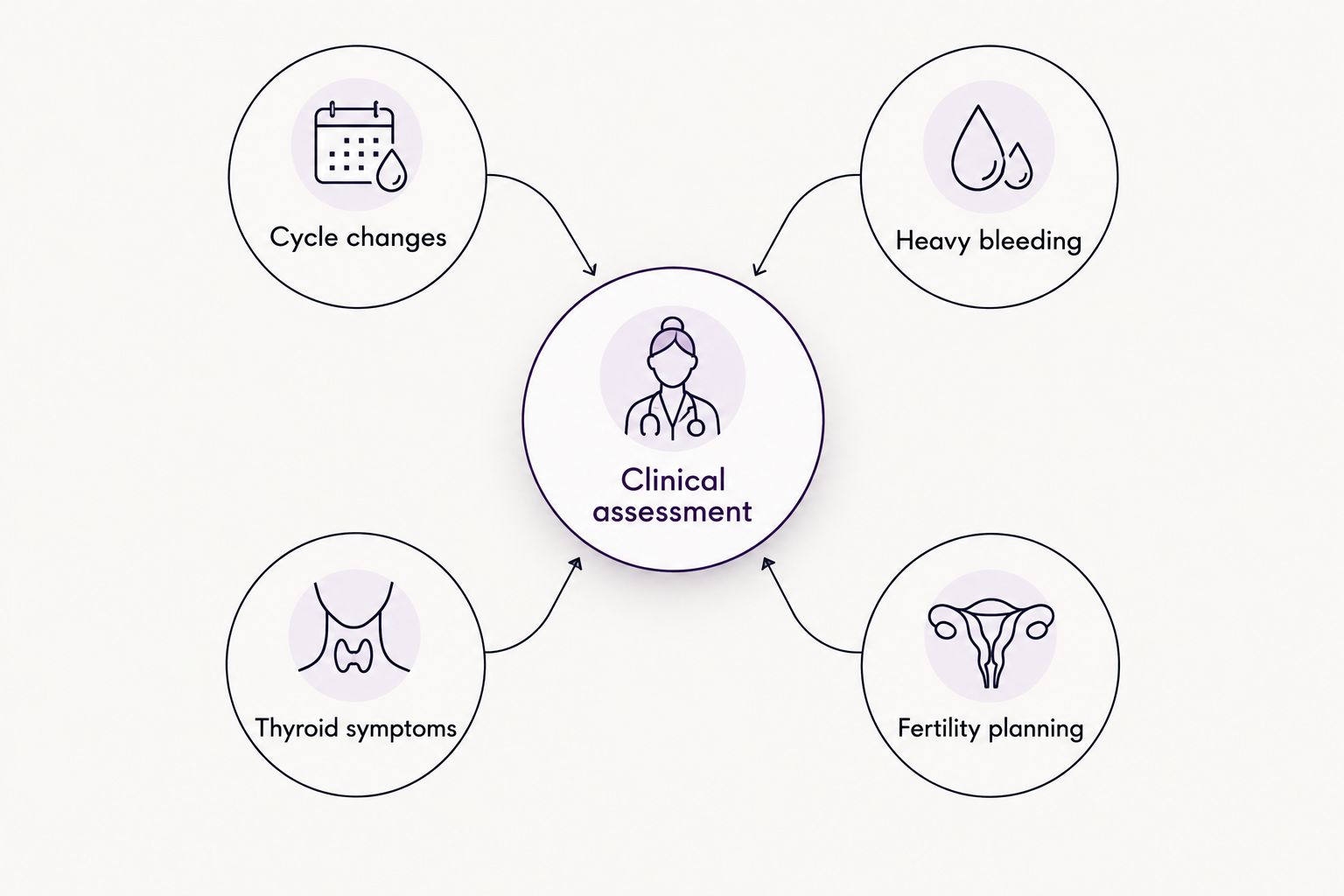
Match the symptom to the testing question
Before selecting bloodwork, separate these concerns:
- Cycle changes: Review age, pregnancy possibility, medications and the pattern of missed or irregular periods.
- Heavy bleeding: Assess blood loss and whether anemia testing or further gynecologic evaluation is needed.
- Thyroid symptoms: Discuss symptoms and history that justify thyroid testing.
- Fertility planning: Ask whether a reproductive endocrinology assessment would answer the actual question.
A symptom can belong in more than one group. The purpose of this checklist is to organize the consultation, not to diagnose yourself.
How the testing approaches rank
The 2026 ranking prioritizes clinical purpose, interpretability and the likelihood that a result changes care. It follows the distinction in NICE menopause guidance between clinical diagnosis in typical presentations and selective testing when age or circumstances warrant investigation.
ACOG's patient guidance on the menopause years informs the discussion of fluctuating hormones. ASRM's committee guidance on ovarian reserve testing informs the limits described for AMH. These are clinical guidance sources, not comparative trials proving that one commercial panel outperforms another.
Which hormone panel should you choose?
Choose a clinician-led assessment first, then the smallest set of tests that answers the remaining questions. If you are aged 45 years or older with characteristic symptoms and cycle changes, routine reproductive hormone testing often adds no diagnostic value.
Choose FSH-based investigation for an appropriate early-menopause question, CBC and ferritin for suspected blood-loss-related iron deficiency, and thyroid testing for a thyroid concern. Keep AMH tied to a specific fertility discussion.
Directcare offers access to licensed clinicians for blood testing and HRT care. The useful next step is a symptom-led consultation—not requesting every test in this ranking.
FAQ
What's the best hormone panel for perimenopause in 2026?
The best hormone panel for perimenopause is a clinician-selected set of tests that answers a specific clinical question. Many otherwise healthy people aged 45 years or older with characteristic symptoms and menstrual changes do not need routine reproductive hormone testing.
Can a normal FSH result rule out perimenopause?
No, a normal FSH result cannot rule out perimenopause. FSH fluctuates during the transition, so clinicians interpret it alongside age, symptoms, menstrual history and medication use.
Should I test estradiol to decide whether I need HRT?
An estradiol result alone does not determine whether you need HRT. Clinicians assess symptoms, medical history, risks and treatment preferences rather than using a single estrogen measurement as a treatment threshold.
Is AMH better than FSH for diagnosing perimenopause?
AMH is not a routine diagnostic test for perimenopause. It has specific uses in fertility care, but neither AMH nor FSH provides a dependable stand-alone diagnosis in a typical menopause transition.
What should I test if I have heavy periods and feel exhausted?
A clinician can assess whether a CBC and ferritin are appropriate to investigate anemia and iron deficiency. Heavy bleeding also needs evaluation of its cause; bloodwork alone does not complete that assessment.
Can I get pregnant during perimenopause?
Yes, pregnancy remains possible during perimenopause because ovulation can still occur. Discuss contraception and pregnancy testing when relevant rather than assuming irregular periods mean fertility has ended.
Should I stop hormonal contraception before a hormone panel?
Do not stop hormonal contraception on your own for testing. Tell the clinician what you take so they can decide whether testing is useful and explain how the medication affects interpretation.
One last thing
Before a 2026 blood draw, write this question beside every requested test: What changes if the result is normal, and what changes if it is abnormal? If neither answer affects care, that test needs a clearer purpose.
This guide provides general education, not a personal diagnosis. Seek urgent medical care for severe bleeding accompanied by fainting, chest pain or significant shortness of breath rather than waiting for a routine panel.