
Best overall for female-pattern hair loss: topical minoxidil. Best prescription alternative when topical treatment is unsuitable: low-dose oral minoxidil. Best for confirmed deficiency-related shedding: targeted nutrient replacement. This 2026 guide ranks the best hair regrowth treatments for women by the cause of hair loss—not by the loudest product claim.
- Topical minoxidil leads the best hair regrowth treatments for women with female-pattern thinning, but requires continued use.
- Oral minoxidil and spironolactone need clinician oversight; neither is suitable for pregnancy.
- Nutrient replacement treats confirmed deficiencies, not every cause of hair shedding.
- Directcare connects women with licensed clinicians for prescription hair regrowth care and blood lab testing.
Directcare is best for women seeking a licensed-clinician assessment before choosing prescription hair regrowth treatment. You can explore Directcare for that route; the ranking below compares treatment categories, not the platform's individual prescriptions.
Why this matters
A widening part, sudden shedding after illness, and smooth bald patches are different problems. A treatment that helps female-pattern hair loss does not automatically treat alopecia areata, scalp inflammation, or shedding after rapid weight loss.
For your 2026 treatment plan, identify the pattern before choosing the product. The American Academy of Dermatology emphasizes diagnosing the cause because women can have more than one cause of hair loss at the same time.
Get prompt dermatology assessment for scalp pain, burning, pustules, shiny scarred areas, or loss of eyebrow hair. Treating suspected scarring hair loss as ordinary thinning can delay care while follicles are permanently damaged.
What makes the best hair regrowth treatment for women?
Use these criteria to judge the options before comparing them:
- Diagnosis fit: Does the treatment address female-pattern thinning, temporary shedding, or a documented deficiency?
- Evidence: Are there clinical studies for the specific condition, rather than claims about healthier-looking hair?
- Safety: Do pregnancy plans, blood pressure, kidney health, or other medications change the choice?
- Practicality: Can you keep up with scalp application, tablets, device sessions, or office visits?
- Maintenance: Does the benefit require continued treatment, or does treatment end after correcting a trigger?
- Monitoring: Does the option need a prescription, laboratory testing, or examination by a dermatologist?
There is no universal winner for every woman. Topical minoxidil earns the default position for female-pattern hair loss; diagnosis-specific treatments win when a different cause is established.
Hair regrowth treatments at a glance
| Rank and treatment | Best for | Standout feature | Key limitation |
|---|---|---|---|
| 1. Topical minoxidil | First-line female-pattern thinning | Established evidence and FDA-approved formulations for women | Scalp application and continued use |
| 2. Low-dose oral minoxidil | Women who cannot tolerate or sustain topical treatment | Avoids applying medicine to the scalp | Off-label; systemic side effects |
| 3. Spironolactone | Selected women with androgen-related thinning | Reduces androgen effects | Off-label; pregnancy and monitoring considerations |
| 4. Targeted nutrient replacement | Confirmed deficiency-related shedding | Corrects an identified contributor | Does not treat unrelated hair loss |
| 5. Low-level light therapy | A non-drug adjunct for pattern hair loss | Home device option | Device-specific evidence and repeated sessions |
| 6. Platelet-rich plasma | Women considering an office-based adjunct | Uses injections prepared from the patient's blood | Variable protocols and injection-related discomfort |
1. Topical minoxidil: best for female-pattern hair loss
Topical minoxidil helps stimulate hair growth in female-pattern hair loss, which often shows up as a gradually widening part. It does not correct every cause of shedding, and it cannot restore follicles destroyed by scarring.
Women's formulations include 5% foam used once daily and 2% solution used twice daily under their respective US labeling. Follow the exact product directions; a higher concentration or more frequent application is not automatically a better treatment.
Topical minoxidil pros:
- Has established clinical evidence for female-pattern hair loss.
- Includes FDA-approved formulations for women.
- Treats the scalp without taking a systemic prescription medicine.
Topical minoxidil cons:
- Can cause irritation, unwanted facial hair, and early temporary shedding.
- Requires continued use to maintain treatment-dependent gains.
- Is not recommended during pregnancy or breastfeeding.
Best for: Women with confirmed female-pattern thinning who can maintain a consistent scalp routine.
Give treatment time. The American Academy of Dermatology advises that results can take 6–12 months; document your baseline rather than judging daily shedding alone. Part your hair and apply the product to the scalp, not just the strands.
Verdict: Buy—after confirming the hair-loss pattern and checking that the product is appropriate for you.
2. Low-dose oral minoxidil: best when scalp treatment is impractical
Low-dose oral minoxidil is a prescription option clinicians use off-label for hair loss. It avoids topical application, but taking a tablet exposes the whole body to the medicine.
Oral minoxidil is FDA-approved for severe hypertension, not hair regrowth. Its prescribing information carries serious cardiovascular warnings, so a hair-loss prescription requires a separate discussion of dose, medical history, and monitoring.
Low-dose oral minoxidil pros:
- Avoids residue and direct scalp irritation from topical products.
- Offers an alternative when consistent scalp application is difficult.
- Can be considered after topical intolerance or an inadequate response.
Low-dose oral minoxidil cons:
- Can cause unwanted body or facial hair, swelling, dizziness, and a faster heartbeat.
- Requires review of cardiovascular history and other medicines.
- Is unsuitable during pregnancy; breastfeeding also requires medical guidance.
Best for: Women with pattern hair loss whose clinician determines that topical treatment is unsuitable.
Do not borrow someone else's tablets or copy a dose from social media. Tell the prescriber about low blood pressure, fainting, heart disease, kidney disease, and medicines that lower blood pressure. New chest pain, breathlessness, or substantial swelling needs urgent medical assessment.
Verdict: Hold—choose low-dose oral minoxidil only after a clinician evaluates systemic risks.
3. Spironolactone: best for selected androgen-related thinning
Spironolactone reduces androgen effects and is prescribed off-label for female-pattern hair loss in selected women. Acne, increased facial hair, or irregular periods can also prompt an evaluation for androgen excess, but none of those findings proves a diagnosis alone.
Spironolactone is not a substitute for identifying the cause of hair loss. Normal blood androgen levels also do not automatically rule out female-pattern thinning.
Spironolactone pros:
- Addresses androgen signaling rather than relying on growth stimulation alone.
- Can fit a treatment plan when acne accompanies hair thinning.
- Can be combined with minoxidil when a clinician considers the combination appropriate.
Spironolactone cons:
- Can cause dizziness, breast tenderness, increased urination, and menstrual changes.
- Can raise potassium, especially with kidney disease or interacting medicines.
- Must be avoided during pregnancy.
Best for: Women whose clinician identifies a suitable role for antiandrogen treatment.
Discuss pregnancy plans and contraception before starting. Potassium and kidney-function testing depend on your health, age, and other medicines; do not assume everyone's monitoring schedule is identical. Potassium supplements and potassium-containing salt substitutes also belong in the medication review.
Verdict: Hold—use spironolactone only with a prescription and an individualized safety plan.
4. Targeted nutrient replacement: best for deficiency-related shedding
Targeted nutrient replacement treats an established deficiency, such as iron deficiency, rather than treating hair loss as a supplement shortage by default. Your history, diet, symptoms, and examination determine whether blood testing is useful.
Rapid weight loss, restrictive eating, heavy menstrual bleeding, and inadequate protein intake are relevant clues. They are reasons to investigate—not proof that a particular supplement will regrow hair.
Targeted nutrient replacement pros:
- Corrects a documented contributor to shedding.
- Connects treatment to a measurable clinical finding.
- Avoids stacking unrelated ingredients when replacement is specific.
Targeted nutrient replacement cons:
- Does not reverse female-pattern thinning by itself when no deficiency exists.
- Excess supplementation can be harmful; excess vitamin A or selenium can contribute to hair loss.
- High-dose biotin can interfere with some laboratory tests.
Best for: Women with a confirmed deficiency or nutritional shortfall linked to their shedding.
Directcare offers blood lab testing alongside hair regrowth care, but the appropriate tests depend on clinical assessment. Ask what each test would change. A broad supplement bundle is not a substitute for checking whether heavy bleeding, dietary restriction, or another condition needs treatment.
Verdict: Hold—replace an identified deficiency, not an assumed one.
5. Low-level light therapy: best for a non-drug adjunct
Low-level light therapy uses light-emitting devices, including certain caps and combs, to treat pattern hair loss. Some devices have FDA clearance, which is different from FDA drug approval.
Clinical studies support benefit for certain devices, but results cannot be transferred automatically to every product with red lights. The exact device, intended users, instructions, and study population matter.
Low-level light therapy pros:
- Provides a non-drug option for pattern hair loss.
- Allows treatment at home with an appropriate device.
- Can serve as an adjunct when a clinician supports the combination.
Low-level light therapy cons:
- Requires repeated sessions according to device instructions.
- Evidence and treatment schedules differ between devices.
- Does not diagnose or correct inflammatory scalp disease or nutritional deficiencies.
Best for: Women with diagnosed pattern hair loss who want a non-drug addition to their plan.
Before choosing a device in 2026, check its actual FDA clearance and intended use rather than accepting a generic medical-grade claim. Review light-sensitivity conditions and photosensitizing medicines with your clinician. Keep expectations tied to the device's evidence, not photographs from unrelated products.
Verdict: Hold—consider a device-specific option after diagnosis and review of its evidence.
6. Platelet-rich plasma: best for an office-based adjunct
Platelet-rich plasma, or PRP, involves drawing blood, preparing a platelet-rich portion, and injecting it into the scalp. Studies report improvement in some patients with pattern hair loss, but preparation methods and treatment schedules vary.
PRP is a procedure, not a standardized bottle of medicine. The clinician's diagnosis and protocol matter, and an impressive before-and-after image does not establish your likely response.
Platelet-rich plasma pros:
- Offers an office-based option for selected patients with pattern hair loss.
- Uses material prepared from the patient's own blood.
- Can be considered alongside established medical treatment.
Platelet-rich plasma cons:
- Involves needles, discomfort, bruising, and procedural infection risk.
- Lacks a single standardized preparation or maintenance schedule.
- Does not guarantee regrowth or replace treatment of an underlying cause.
Best for: Women seeking a dermatologist-led procedural adjunct after discussing established options.
Ask what diagnosis the procedure treats, how improvement will be documented, and what happens if there is no response. Clarify the proposed course before agreeing to repeat sessions. The use of your own blood does not make PRP risk-free.
Verdict: Hold—consider PRP after discussing less invasive options and realistic outcomes.
How this ranking works
This 2026 ranking prioritizes diagnosis fit, clinical evidence, safety, daily burden, and monitoring. It is not a head-to-head trial or a claim that every woman should follow the same sequence.
The clinical distinctions follow established American Academy of Dermatology patient guidance on female-pattern hair loss, FDA labeling for minoxidil, and prescribing information for oral minoxidil and spironolactone. Those sources address different scopes: patient treatment choices, approved uses, and medication risks.
Nutrient replacement ranks above optional devices and procedures when a deficiency is confirmed. That does not make supplements a general alternative to minoxidil.
Which hair regrowth treatment should you choose?
Choose topical minoxidil as the default discussion for confirmed female-pattern hair loss. Choose diagnosis first if the loss is sudden, patchy, painful, or accompanied by scalp changes.
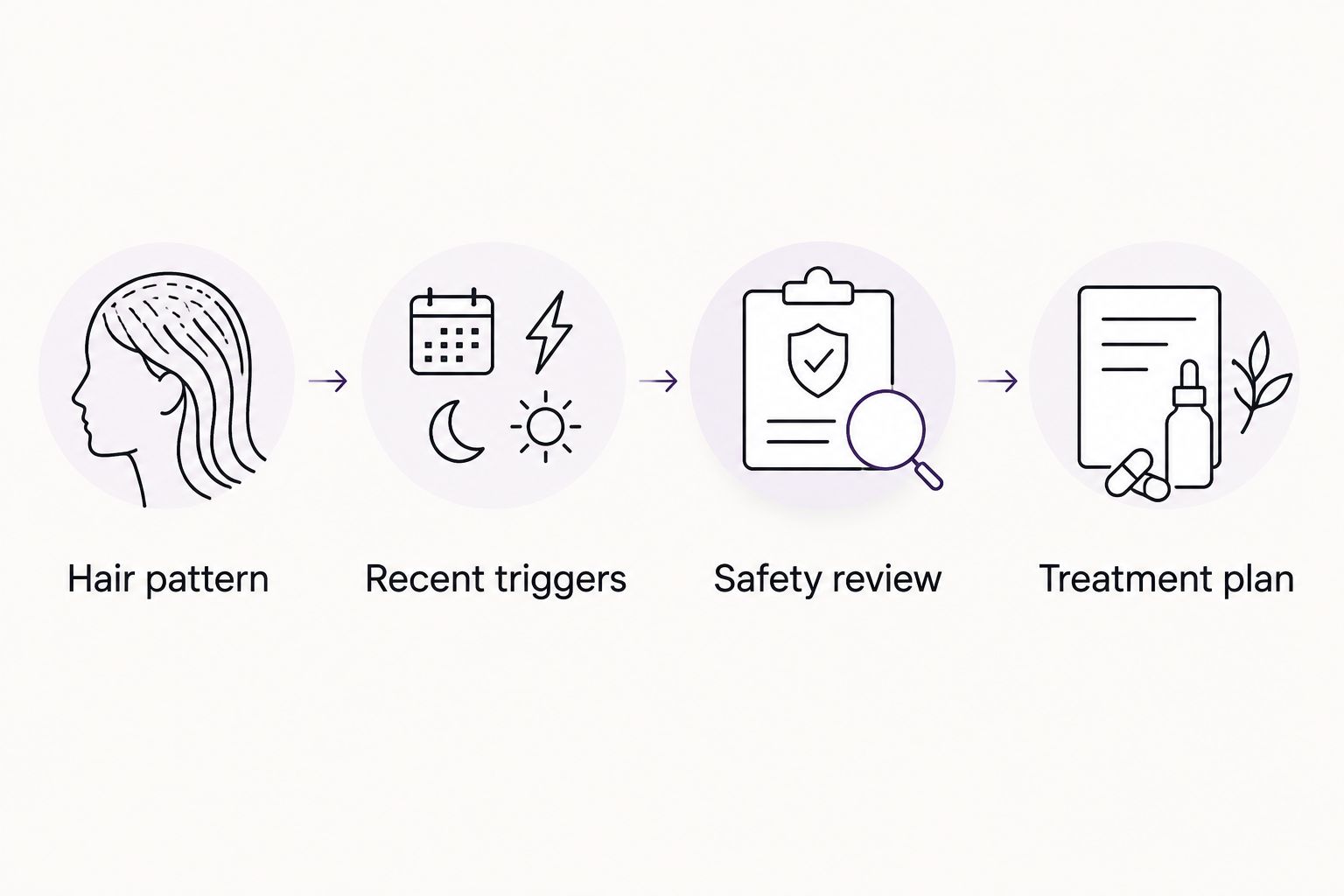
For a practical appointment, organize your information under these headings:
- Hair pattern: Where thinning started and whether the scalp has symptoms.
- Recent triggers: Illness, childbirth, rapid weight loss, medication changes, or restrictive eating.
- Safety review: Pregnancy plans, medical conditions, medicines, and supplements.
- Treatment plan: The chosen option, expected review point, and reasons to contact the clinician sooner.
Bring photographs taken with the same part, lighting, and angle. Consistent images make the discussion more useful than comparing hair collected on different wash days.
Directcare connects women with licensed clinicians for prescription hair regrowth care. An in-person scalp examination remains important when symptoms suggest inflammation, scarring, or an uncertain diagnosis.
FAQ
What's the best hair regrowth treatment for women in 2026?
Topical minoxidil is the default first-line option for many women with female-pattern hair loss. Sudden shedding, bald patches, and inflamed or scarred areas need diagnosis-specific care instead.
Is 5% minoxidil better than 2% for women?
Both 5% foam and 2% solution have FDA-approved formulations for women, with different application instructions. Choose according to the product labeling, tolerability, and clinician advice rather than concentration alone.
How long does minoxidil take to regrow hair?
Visible results can take 6–12 months, according to American Academy of Dermatology patient guidance. Continued use is needed to maintain treatment-dependent gains.
Is oral minoxidil better than topical minoxidil?
Oral minoxidil is not automatically better than topical minoxidil. It avoids scalp application but is off-label for hair loss and adds systemic risks that require clinician assessment.
Can women use spironolactone for hair loss?
Clinicians prescribe spironolactone off-label for selected women with female-pattern hair loss. Pregnancy plans, kidney function, potassium risk, and interacting medicines affect whether it is appropriate.
Do biotin supplements regrow women's hair?
Biotin is not an established treatment for hair loss in women without a biotin deficiency. High-dose biotin can interfere with some laboratory tests, so tell your clinician and laboratory if you take it.
Can I use hair regrowth treatments during pregnancy?
Do not start minoxidil or spironolactone during pregnancy. Ask your obstetric clinician or dermatologist to assess the cause of hair loss and discuss pregnancy-appropriate care.
When should I see a dermatologist instead of trying a product?
Seek prompt dermatology assessment for scalp pain, burning, pustules, shiny scarred areas, or eyebrow loss. Sudden patches or an unclear diagnosis also warrant evaluation rather than repeated product changes.
One last thing
Early shedding after starting minoxidil is not the same as treatment failure. It can occur as follicles change their growth cycle, but persistent, severe, or symptomatic shedding deserves a clinician review rather than automatic reassurance.
For your 2026 plan, write down the start date, application schedule, side effects, and agreed follow-up. Change treatment for a clinical reason—not because a single shower looked worse. Avoid starting several optional products together; otherwise, identifying the cause of irritation becomes harder.