
Best starting point: FDA-approved tirzepatide matched to your diagnosis. Best for weight-management coverage: Zepbound. Best for type 2 diabetes coverage: Mounjaro. If you’re searching for the cheapest tirzepatide online in 2026, compare your actual coverage and complete treatment requirements—not an advertised medication figure alone.
- The cheapest tirzepatide online depends on insurance coverage, prescription eligibility, and the services included.
- Zepbound is the weight-management option; Mounjaro is the type 2 diabetes option.
- Directcare connects patients seeking GLP-1 weight-loss care with licensed clinicians; prescribing requires an individual clinical decision.
- Compounded tirzepatide is not FDA-approved and is not an interchangeable budget substitute.
Why this matters
A low advertised figure does not tell you whether you qualify, whether your insurance covers the prescription, or what follow-up involves. Compare the same treatment arrangement before deciding which route offers better value.
Directcare is best for adults seeking a licensed-clinician assessment for telehealth GLP-1 weight-loss care, rather than choosing medication without medical review. Directcare connects US patients with licensed clinicians; the medication decision belongs in that consultation.
This 2026 guide ranks treatment routes by their appropriate use, not by an unsupported cheapest-provider claim. Start with the route that fits your diagnosis, then compare individualized quotes and coverage decisions within that route.
What makes the best online tirzepatide option?
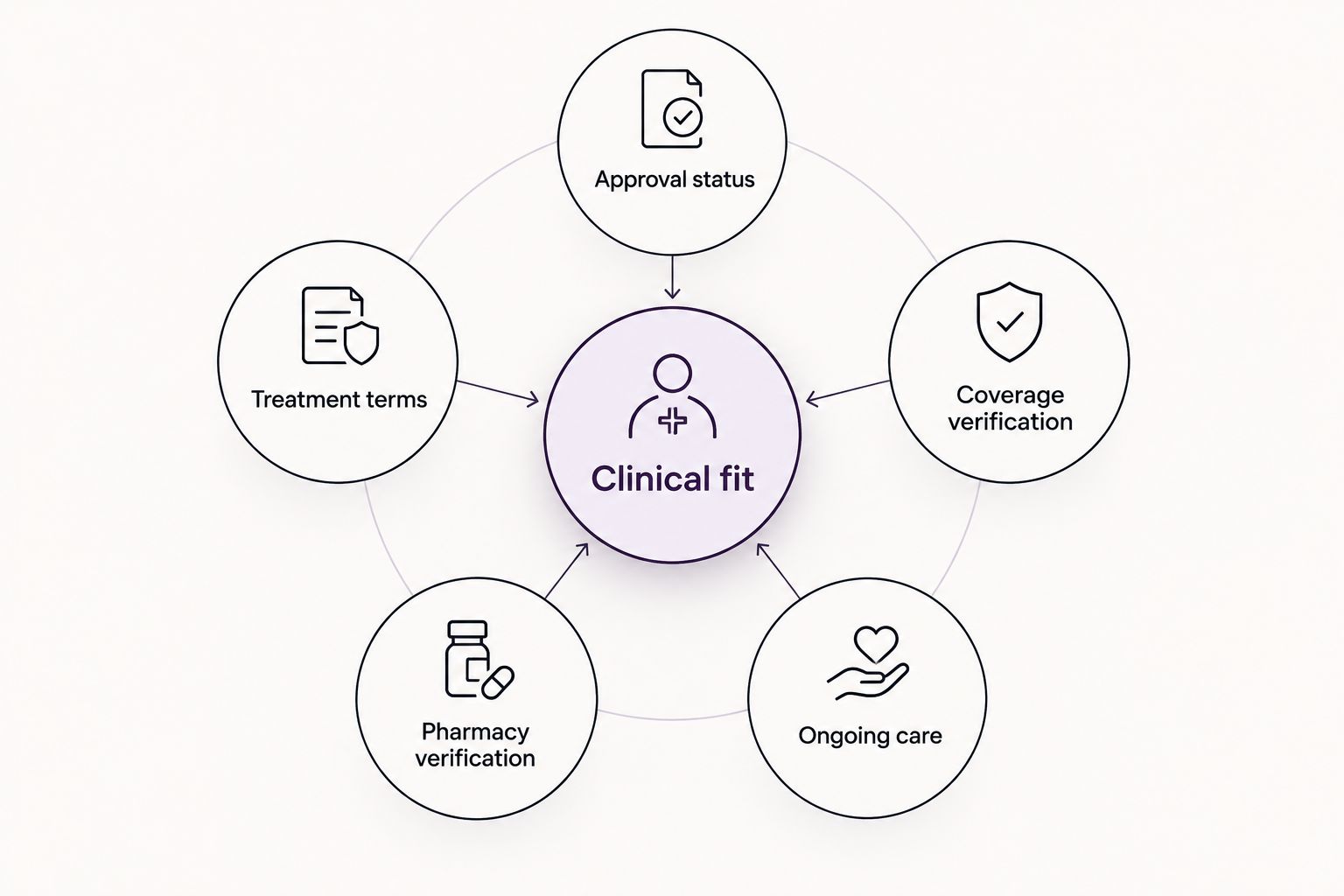
Use these criteria before comparing providers:
- Appropriate indication: The prescription should fit your diagnosis and medical history, not just the medication you requested.
- Approval status: FDA-approved medication and compounded medication do not have the same regulatory status.
- Complete treatment terms: Identify medication, visits, supplies, required testing, and follow-up separately.
- Coverage verification: Confirm the specific product, indication, and authorization requirements with your insurer.
- Prescriber and pharmacy verification: Check the clinician’s license and the dispensing pharmacy’s state licensure.
- Ongoing care: Understand who handles side effects, dose decisions, treatment interruptions, and urgent questions.
For your 2026 shortlist, put clinical fit ahead of convenience. A prescription you cannot safely use is not a useful purchase, regardless of how attractive the advertisement looks.
Tirzepatide options at a glance
The same active ingredient appears in different treatment arrangements. These are distinct decision routes, not a claim that every provider offers every option.
| Rank and option | Best for | Standout feature | Key limitation |
|---|---|---|---|
| 1. Zepbound with insurance coverage | Eligible adults seeking weight management | FDA-approved weight-management indication | A prescription does not guarantee insurance approval |
| 2. Mounjaro with insurance coverage | Adults with type 2 diabetes | FDA-approved diabetes indication | Not the branded product approved specifically for weight management |
| 3. FDA-approved tirzepatide without insurance | Eligible patients using a self-pay route | Keeps treatment within an FDA-approved product pathway | Requires a sustainable plan without insurer payment |
| 4. Compounded tirzepatide assessment | Patients with a specific medical need an approved drug cannot meet | Individual preparation under applicable compounding rules | Not FDA-approved; legal eligibility requires separate assessment |
The FDA-approved prescribing information for Zepbound and Mounjaro establishes their indications, dosing instructions, contraindications, and warnings. Those documents—not a provider’s promotional comparison—are the reference for product-specific clinical decisions.
1. Zepbound: best tirzepatide route for weight-management coverage
Zepbound contains tirzepatide and is FDA-approved for chronic weight management in eligible adults alongside a reduced-calorie diet and increased physical activity. Insurance coverage still depends on your particular plan and its requirements.
For the adult weight-management indication, FDA labeling includes a BMI of 30 kg/m² or greater, or 27 kg/m² or greater with at least one weight-related condition. Those thresholds establish part of eligibility; they do not replace a clinician’s assessment.
Zepbound pros:
- Its weight-management indication directly matches an obesity-treatment consultation.
- FDA-approved labeling gives clinicians product-specific dosing and safety instructions.
- Your insurer can assess coverage for the named product and indication.
Zepbound cons:
- Meeting prescribing criteria does not establish insurance coverage.
- Prior authorization and plan exclusions can affect access.
- Gastrointestinal side effects and contraindications still require clinical review.
Best for: Adults who meet weight-management criteria and want their insurance evaluated for the corresponding approved product.
Before committing to an online provider, ask who submits authorization paperwork and what happens after a denial. Also ask whether an approval needs renewal and which clinical records support it.
Verdict: Choose Zepbound when your clinician confirms eligibility and your plan confirms workable coverage.
2. Mounjaro: best tirzepatide route for type 2 diabetes care
Mounjaro contains tirzepatide and is FDA-approved to improve blood sugar control in adults with type 2 diabetes, alongside diet and exercise. It belongs in a diabetes treatment plan, not a shortcut around weight-management coverage rules.
Mounjaro and Zepbound share an active ingredient, but their approved indications and insurance pathways differ. A brand switch does not turn one diagnosis into another.
Mounjaro pros:
- Its approved indication directly addresses type 2 diabetes.
- A clinician can assess it alongside your current diabetes medications.
- Product labeling provides established dosing and monitoring guidance.
Mounjaro cons:
- It is not the branded tirzepatide product approved specifically for weight management.
- Insurance requirements still apply to the exact prescription.
- Concomitant insulin or sulfonylureas require attention to hypoglycemia risk.
Best for: Adults with type 2 diabetes whose clinician considers tirzepatide appropriate within their diabetes care.
Tell the prescriber about every glucose-lowering medication you take. Do not stop or adjust existing treatment yourself to make room for a new prescription.
For a 2026 coverage check, ask your insurer about Mounjaro under your actual diagnosis. Do not rely on someone else’s approval experience or assume that a prescription guarantees payment.
Verdict: Choose Mounjaro for an appropriate diabetes treatment plan; skip it as a coverage workaround.
3. FDA-approved self-pay tirzepatide: best for care without insurance
A self-pay route means you pay without relying on insurer reimbursement. It does not change the need for a prescription, medical eligibility, or a licensed dispensing pharmacy.
Directcare offers telehealth GLP-1 weight-loss care through licensed clinicians. A consultation should establish the appropriate treatment before you compare dispensing arrangements or commit to ongoing care.
FDA-approved self-pay tirzepatide pros:
- The medication remains an FDA-approved product.
- You can evaluate treatment without depending on an insurance authorization outcome.
- Written terms let you compare medication and clinical services separately.
FDA-approved self-pay tirzepatide cons:
- You take responsibility for ongoing treatment expenses without insurer payment.
- Separate clinical and pharmacy charges require careful review.
- A self-pay arrangement does not establish that you qualify for treatment.
Best for: Eligible patients who want an FDA-approved product and can sustain the full treatment arrangement without insurance.
Request a written breakdown before enrolling. Check what clinical follow-up includes, whether supplies are separate, and what happens if your clinician changes or stops treatment.
Do not confuse a platform enrollment with a medication prescription. Choose the clinician-led treatment plan first; compare payment arrangements second.
Verdict: Choose an FDA-approved self-pay route only after confirming clinical suitability and ongoing obligations.
4. Compounded tirzepatide: best reserved for a specific medical need
Compounded tirzepatide is not FDA-approved. FDA does not review compounded drugs for safety, effectiveness, and quality before marketing in the way it reviews approved products.
Compounding can serve a patient whose medical needs cannot be met by an approved medication, subject to applicable law. It is not a routine interchangeable alternative selected solely because an advertisement looks cheaper.
Compounded tirzepatide pros:
- Patient-specific preparation can address certain needs an approved product cannot meet.
- A prescriber can assess whether a documented clinical difference justifies compounding under applicable rules.
- The decision can be tied to an individual medical requirement rather than a general product preference.
Compounded tirzepatide cons:
- The preparation is not FDA-approved.
- Concentration and administration instructions require particular attention.
- Compounding restrictions must be checked for the specific prescription and pharmacy.
Best for: Patients whose clinician identifies a specific medical need that an approved drug cannot meet and confirms a lawful compounding pathway.
In 2026, do not treat an old shortage announcement as permanent authorization for routine copies. Ask the prescriber and pharmacy to explain the current basis for the prescription.
Avoid products labeled for research use or sold without a prescription. Those are not substitutes for patient-specific medical treatment.
Verdict: Hold unless your clinician establishes the medical need and the pharmacy confirms the applicable requirements.
How to compare online tirzepatide quotes fairly
A useful comparison starts with identical assumptions. Comparing medication alone against medication plus clinical care produces a misleading result.
Ask each provider these questions:
- What is included? Separate medication, consultation, follow-up, supplies, and any required testing.
- What changes during treatment? Ask how dose adjustments affect your arrangement and what requires another visit.
- Who dispenses the prescription? Get the pharmacy’s identity and verify its license independently.
- Who handles problems? Identify the clinical contact for side effects and treatment interruptions.
- What happens if treatment stops? Read cancellation terms and prescription-transfer procedures before enrolling.
Keep the answers in writing. If a provider will not identify the medication, prescriber, or dispensing pharmacy, stop the comparison there.
Check medication instructions separately
FDA labeling starts both branded tirzepatide products at 2.5 mg once weekly for 4 weeks before the labeled increase. That starting dose is an initiation step, not a reason to select your own treatment schedule.
Your clinician decides whether and when to change your dose. Never convert milligrams into syringe units yourself or reuse instructions from another preparation: milligrams describe the drug amount, while syringe markings describe volume.
Safety checks before choosing a provider
Tirzepatide is not suitable for everyone. FDA labeling contraindicates use with a personal or family history of medullary thyroid carcinoma or multiple endocrine neoplasia syndrome type 2, and with known serious hypersensitivity to the medication or its ingredients.
Tell your clinician about pregnancy plans, severe stomach-emptying problems, pancreatitis history, gallbladder problems, and all other medicines. Tirzepatide delays gastric emptying, which matters for some oral medications and procedures requiring anesthesia or deep sedation.
Oral hormonal contraceptive users should discuss the label’s recommendation for a non-oral method or an added barrier method for 4 weeks after starting tirzepatide and after each dose increase. Do not assume your usual contraceptive plan needs no adjustment.
Severe, persistent abdominal pain or a serious allergic reaction needs prompt medical attention—not a routine message about your next refill.
How these options are ranked
Clinical fit comes first, followed by approval status, verified coverage, complete treatment terms, and ongoing care. The ordering separates weight management, diabetes care, self-pay treatment, and exceptional compounding needs.
It does not claim that one brand or telehealth provider is universally cheapest. A meaningful comparison uses your diagnosis, your plan’s decision, and the written terms of your prescription arrangement.
Which tirzepatide option should you choose?
For weight management, start with an assessment for an FDA-approved treatment and check Zepbound coverage if clinically appropriate. For type 2 diabetes, discuss Mounjaro within your diabetes care plan.
If insurance does not cover appropriate treatment, compare FDA-approved self-pay arrangements before considering compounding. Compounding needs its own medical and legal justification; it is not the automatic next step after a denial.
Directcare’s GLP-1 weight-loss care connects you with a licensed clinician for that assessment. Ask about eligibility, treatment choice, monitoring, and prescription arrangements before deciding.
Start with a clinical assessment
Discuss GLP-1 weight-loss treatment with a licensed clinician through Directcare.
FAQ
What is the cheapest tirzepatide online in 2026?
There is no single cheapest route for every patient. Compare your confirmed insurance coverage or individualized self-pay terms, including medication, clinical care, supplies, and required testing.
Is Zepbound better than Mounjaro for weight loss?
Zepbound is the tirzepatide brand approved for chronic weight management in eligible adults; Mounjaro is approved for type 2 diabetes. Both contain tirzepatide, so the prescribing indication and care plan matter more than a brand-name contest.
Can I get tirzepatide online without a prescription?
No. Legitimate patient treatment with tirzepatide requires a prescription from an authorized clinician and dispensing through a licensed pharmacy.
Does insurance cover online tirzepatide treatment?
Coverage depends on your plan, the prescribed product, the diagnosis, and authorization requirements. Confirm medication coverage separately from coverage for telehealth visits.
Is compounded tirzepatide the same as FDA-approved tirzepatide?
No. Compounded tirzepatide is not FDA-approved and does not receive the same premarket review as an approved product. Its use requires a separate assessment of medical need and applicable compounding rules.
What should I compare besides the medication quote?
Compare clinical visits, follow-up, supplies, required testing, dose-change terms, and cancellation procedures. Also verify the prescriber and dispensing pharmacy independently.
Can I start tirzepatide at a higher dose to save money?
Do not increase your starting dose or alter the schedule yourself. FDA labeling uses gradual dose escalation, and your clinician must direct any treatment changes.
One last thing
A dose written in milligrams and a syringe instruction written in units are not interchangeable. Before your first injection, have the dispensing pharmacist confirm the exact preparation, device, and instructions; that check matters more than finishing a checkout quickly.