
There is no single best testosterone delivery method in 2026: injections suit dose adjustment, gel suits needle-free treatment, and pellets suit avoiding daily dosing. This guide compares those options with oral and nasal testosterone, including the trade-offs that matter before you choose a prescription with your clinician.
- The best testosterone delivery method depends on monitoring, household exposure, dosing preferences, and fertility plans.
- Injections allow dose adjustment but involve needles and potential fluctuations between doses.
- Testosterone gel avoids injections but requires daily application and precautions against skin transfer.
- Directcare connects people considering TRT with licensed clinicians through telehealth.
Why this matters
Testosterone replacement therapy, or TRT, treats confirmed testosterone deficiency—not fatigue alone. The Endocrine Society recommends diagnosis only when compatible symptoms occur alongside consistently low testosterone levels.
Directcare is a telehealth option for adults seeking clinician-led evaluation of testosterone concerns. You can start with Directcare to explore its clinician-connected care; the appropriate prescription depends on your assessment, not a delivery-method ranking.
For your 2026 decision, separate two questions: whether testosterone treatment is appropriate, and which formulation fits your health and routine. Changing the delivery method does not remove testosterone’s effects on fertility, blood counts, or blood pressure.
What makes the best testosterone delivery method?
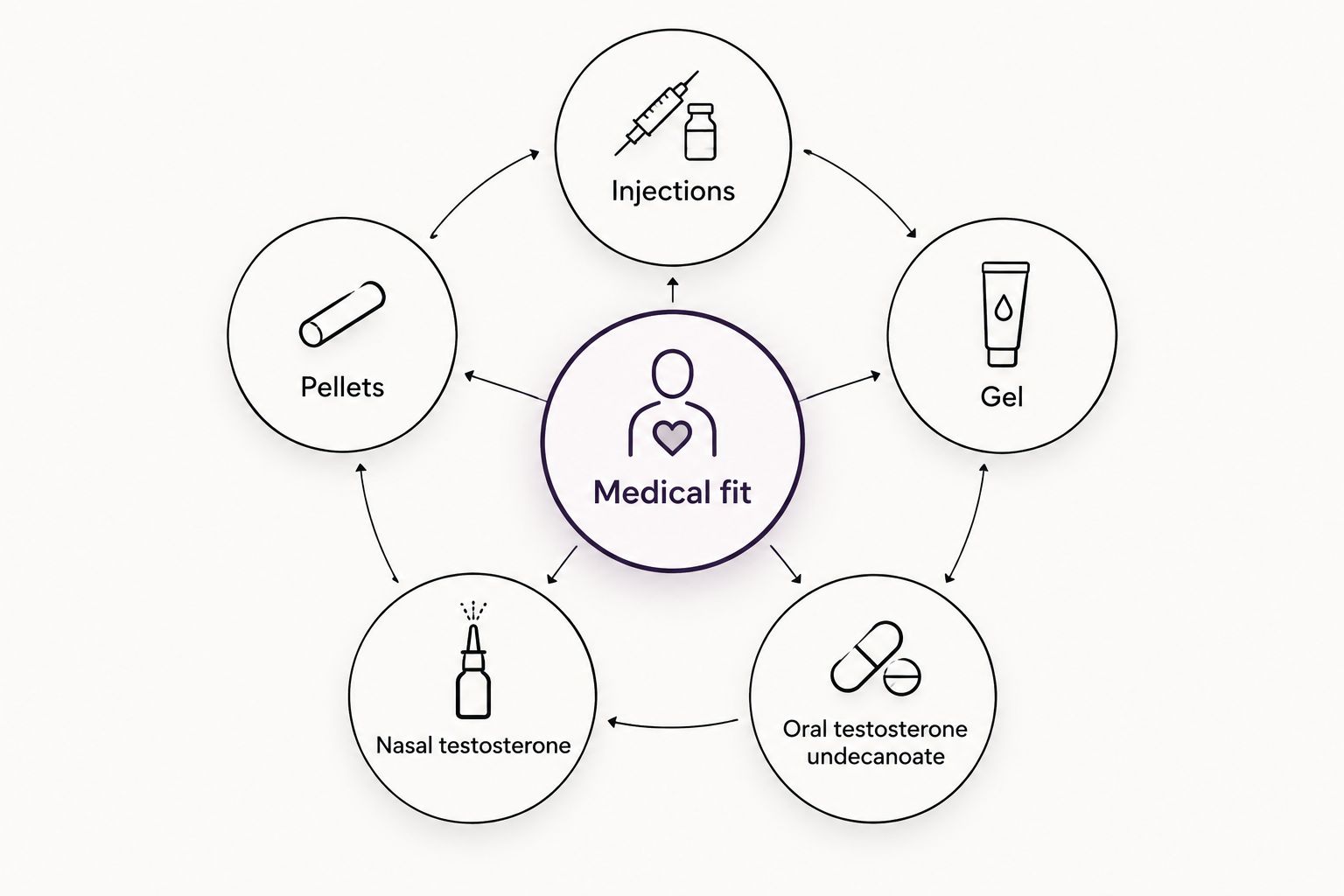
Use these criteria before comparing formulations:
- Dose adjustment: How easily can your clinician change treatment when symptoms, side effects, or laboratory results require it?
- Daily burden: Does treatment require daily attention, scheduled injections, or an office procedure?
- Exposure precautions: Can testosterone transfer to a partner or child through treated skin?
- Medical fit: Do blood pressure, hematocrit, skin conditions, or other health concerns affect the choice?
- Monitoring fit: Can you follow the formulation’s specific instructions for blood-test timing?
- Fertility plans: Do you want biological children? Exogenous testosterone can suppress sperm production regardless of delivery method.
The strongest choice in 2026 is the one you can use correctly and monitor consistently—not whichever formulation sounds most convenient.
Testosterone delivery methods at a glance
| Method | Best for | Standout feature | Key limitation |
|---|---|---|---|
| Injections | Clinician-directed dose adjustment | Dose and interval can be adjusted | Needles and possible peak-to-trough symptoms |
| Gel | Needle-free treatment without a procedure | Daily skin application | Transfer precautions and daily adherence |
| Oral testosterone undecanoate | Avoiding needles and skin application | Swallowed prescription formulation | Product-specific food instructions and blood-pressure monitoring |
| Nasal testosterone | Avoiding injections and treated skin | Application inside the nostrils | Repeated daily dosing and nasal irritation |
| Pellets | Avoiding daily medication tasks | Implanted under the skin | Procedure required; difficult to adjust promptly |
These are different ways to deliver testosterone, not interchangeable prescriptions. The exact formulation determines administration instructions, laboratory timing, and warnings.
1. Injections: best testosterone method for dose adjustment
Injectable testosterone delivers prescribed medication through an injection. Common short-acting formulations include testosterone cypionate and testosterone enanthate; their schedules differ from long-acting injectable products.
Injections rank first here for flexibility, not because they produce better outcomes for everyone. Your clinician can adjust a short-acting regimen in response to symptoms and appropriately timed blood tests.
Injection pros:
- Short-acting regimens allow adjustments to dose and interval.
- Treatment does not leave testosterone on exposed skin.
- Injections avoid a daily skin-application routine.
Injection cons:
- Needles, injection discomfort, and technique are part of treatment.
- Testosterone levels can rise and fall between doses, particularly with longer intervals.
- Injectable formulations can increase hematocrit, requiring monitoring.
Best for: People comfortable with injections who value a clinician-adjustable regimen.
Ask how to time laboratory testing relative to your injection. A result near a peak does not mean the same thing as a result near the end of the dosing interval.
Verdict: Choose injections when dose flexibility matters and you can follow the injection and monitoring plan.
2. Gel: best testosterone method for needle-free treatment
Testosterone gel delivers medication through the skin with daily application. Application sites, drying instructions, washing restrictions, and precautions vary by product.
Gel fits people who want to avoid needles and procedures. Its main practical drawback is preventing another person from contacting the treated area before the product’s precautions have been followed.
Gel pros:
- No injection or implantation procedure is required.
- Daily application supports regular testosterone delivery when absorption is adequate.
- Your clinician can adjust treatment without removing an implant.
Gel cons:
- Testosterone can transfer through skin contact if precautions are not followed.
- Daily application and product-specific washing instructions add routine tasks.
- Absorption varies, and skin irritation can occur.
Best for: People who prefer daily skin application and can reliably follow transfer precautions.
Wash your hands after application and follow the prescription’s instructions for covering or washing the treated area. Do not assume every gel uses the same application site.
Verdict: Choose gel when avoiding needles matters more than avoiding a daily routine.
3. Oral testosterone undecanoate: best for avoiding skin application
Prescription oral testosterone undecanoate is an oral testosterone formulation—not an over-the-counter testosterone booster. Its administration instructions depend on the specific product.
Oral treatment removes needles and treated-skin contact from the routine. It does not remove the need for blood-pressure checks, blood tests, or careful adherence.
Oral testosterone undecanoate pros:
- No injections are required.
- No testosterone-treated skin creates a contact-transfer concern.
- Treatment avoids an implantation procedure.
Oral testosterone undecanoate cons:
- Food and dosing instructions are product-specific and must be followed.
- Blood-pressure increases are a concern and require monitoring.
- Repeated daily medication tasks can be inconvenient.
Best for: People who prefer oral medication and can follow the exact administration instructions.
Ask your clinician how meals affect your prescribed product and when to check blood pressure. Do not substitute another oral testosterone product or change meal timing without guidance.
Verdict: Choose oral testosterone undecanoate when oral dosing fits your routine and your clinician considers it appropriate.
4. Nasal testosterone: best for avoiding injections and treated skin
Nasal testosterone delivers medication inside the nostrils. It uses a different application routine from either skin gel or an injection.
The practical advantage is avoiding both needles and testosterone on exposed skin. The trade-off is repeated dosing during the day, which makes adherence especially important.
Nasal testosterone pros:
- No injection or implantation procedure is required.
- Application avoids a testosterone-treated skin surface.
- Treatment does not involve a long-lasting implant.
Nasal testosterone cons:
- Repeated daily dosing can be difficult to maintain.
- Nasal irritation or discomfort can occur.
- Nasal disease or surgery can affect suitability and requires clinician review.
Best for: People who can maintain repeated daily dosing and prefer neither injections nor skin application.
Do not assume nasal testosterone protects fertility. Exogenous testosterone can suppress sperm production, and fertility goals require a separate discussion before treatment.
Verdict: Choose nasal testosterone only when its dosing routine and nasal-health requirements fit your situation.
5. Pellets: best testosterone method for avoiding daily dosing
Testosterone pellets are placed under the skin during a clinical procedure. They release testosterone over time rather than requiring daily self-administration.
Pellets offer fewer day-to-day medication tasks, but they exchange that convenience for procedural risks and less immediate control over dosing. That matters if side effects develop or your treatment needs change.
Pellet pros:
- No daily application or pill-taking routine is required.
- No testosterone-treated skin creates a transfer concern.
- Treatment avoids repeated self-injections.
Pellet cons:
- Placement requires a procedure, with risks including infection and pellet extrusion.
- Dose changes are less straightforward after implantation.
- Adjusting exposure promptly is harder than with shorter-acting treatment.
Best for: People who prioritize avoiding daily medication tasks and accept a procedure and reduced dosing flexibility.
Discuss what happens if your hematocrit rises or side effects appear after placement. Convenience should include a clear plan for managing problems, not just fewer dosing reminders.
Verdict: Hold on pellets until you understand the procedure and the limits on changing treatment afterward.
Before choosing TRT in 2026: confirm diagnosis and monitoring
The American Urological Association uses total testosterone below 300 ng/dL as a reasonable diagnostic cutoff, alongside symptoms and signs. It recommends 2 early-morning blood tests on separate days before diagnosing low testosterone.
A single result does not establish the whole diagnosis. Acute illness, sleep disruption, medications, and other conditions can affect the interpretation; selected patients need additional testing such as free testosterone or pituitary-related hormones.
Your clinician should also review fertility plans, sleep apnea, cardiovascular history, prostate-related risks where relevant, and baseline blood counts. A delivery-method comparison cannot replace that assessment.
Know the monitoring rules before the first dose
The Endocrine Society recommends checking hematocrit before treatment, again after 3–6 months, and then annually. A hematocrit above 54% requires clinician-directed interruption and evaluation rather than simply continuing the same regimen.
Testosterone measurements must match the formulation. Injection timing, gel application, and oral administration can each affect when a blood sample should be collected.
For your 2026 treatment plan, get clear answers to these questions:
- When should you have blood drawn relative to your dose?
- Which symptoms or side effects require a call?
- How will blood pressure and hematocrit be monitored?
- What happens if testosterone normalizes but symptoms do not improve?
These clinical thresholds come from the American Urological Association’s testosterone-deficiency guideline and the Endocrine Society’s testosterone-therapy guideline for men with hypogonadism. Formulation-specific instructions come from FDA-approved prescribing information; the guidelines do not establish a universal winning delivery method.
How the methods are ranked
This ranking prioritizes dose adjustment, treatment burden, exposure precautions, medical fit, and monitoring. It does not treat convenience as evidence of greater effectiveness or claim that every formulation suits every patient.
Injections lead for adjustable treatment; gel leads for avoiding needles without a procedure. Oral testosterone undecanoate, nasal testosterone, and pellets each solve a different practical problem while adding their own obligations.
Directcare provides clinician-connected telehealth care, not a reason to favor a formulation without an assessment. This comparison does not imply that Directcare prescribes every method listed.
Which testosterone delivery method should you choose?
If you are undecided, discuss short-acting injections and gel first—not because either is universally best, but because they offer contrasting routines without implantation. Injections prioritize adjustable dosing without skin transfer; gel prioritizes needle-free daily treatment.
Choose the remaining methods for a specific reason: oral medication preference, avoidance of treated skin, or fewer daily medication tasks. If fertility is a current goal, pause the delivery-method decision and discuss reproductive options with your clinician first.
FAQ
What's the best testosterone delivery method in 2026?
There is no single best testosterone delivery method for everyone. Injections suit adjustable dosing, gel suits needle-free daily treatment, and other formulations fit specific administration preferences and medical needs.
Are testosterone injections better than gel?
Testosterone injections are not universally better than gel. Injections avoid skin-transfer precautions but require needles; gel avoids injections but requires daily application and careful contact precautions.
Can I take testosterone as a pill instead of an injection?
Prescription oral testosterone undecanoate is an option for appropriately selected patients. Its food instructions, dosing schedule, blood-pressure effects, and monitoring requirements depend on the specific product.
Which testosterone method is safest around children?
A method that does not leave testosterone on exposed skin avoids the specific contact-transfer risk associated with topical gel. Every formulation still requires secure storage and safe handling, and injections introduce sharps safety.
Will nasal testosterone preserve my fertility?
Do not assume nasal testosterone will preserve fertility. Exogenous testosterone can suppress sperm production, so discuss fertility goals before starting any testosterone formulation.
What blood tests do I need before starting TRT?
Diagnosis generally requires symptoms plus consistently low testosterone, confirmed with separate early-morning measurements. Your clinician also reviews blood counts and determines whether additional hormone tests or prostate-related evaluation are appropriate.
Are testosterone pellets easier to stop than injections?
Testosterone pellets are generally harder to adjust promptly than short-acting injections. Pellets remain under the skin after placement, so discuss side-effect management before choosing implantation.
One last thing
A normal testosterone result does not prove that persistent fatigue needs a higher dose. Sleep apnea, anemia, medication effects, and other conditions can overlap with low-testosterone symptoms.
Before changing delivery methods in 2026, ask your clinician whether the problem is administration, absorption, dosing, or a different diagnosis. The best next step is sometimes a better explanation—not more testosterone.