
Best overall for confirmed male pattern hair loss in 2026: clinician-guided finasteride plus topical minoxidil. Best nonprescription option: topical minoxidil; best for rebuilding a hairline: hair transplantation after assessment of ongoing loss.
- The best hair loss treatments for men depend on diagnosis; finasteride plus topical minoxidil addresses different growth mechanisms.
- Topical minoxidil is the leading nonprescription option for male pattern hair loss, but continued treatment is needed.
- Oral minoxidil is off-label for hair loss and requires assessment of cardiovascular risks.
- Directcare connects men seeking hair regrowth treatment with licensed clinicians; treatment selection requires an individual assessment.
Why this matters
A receding hairline, sudden shedding, and round bald patches are not the same diagnosis. This ranking covers androgenetic alopecia, commonly called male pattern hair loss—not every condition that causes thinning.
Male pattern hair loss gradually miniaturizes susceptible follicles. Treatment aims to slow that process, support growth, or redistribute existing hair. Starting a product without identifying the cause can delay the care you actually need.
Directcare is a fit for men seeking clinician-guided hair loss treatment through telehealth. Directcare connects patients with licensed clinicians for hair regrowth care; an in-person examination remains important when scalp findings or the diagnosis require it.
For your 2026 decision, separate three questions: What is causing the loss? Which treatment fits your medical history? Can you maintain the routine?
What makes the best hair loss treatments for men?
- Diagnosis fit: Evidence for male pattern hair loss does not automatically apply to sudden shedding, infection, or scarring alopecia.
- Clinical evidence: Prioritize established treatments over supplements marketed without evidence for your diagnosis.
- Safety: Sexual health, cardiovascular history, scalp sensitivity, and other medications affect the choice.
- Treatment goal: Preserving existing hair differs from rebuilding a hairline where coverage is already sparse.
- Practical adherence: A treatment only helps while you follow the required routine and follow-up.
- Maintenance needs: Medication-supported growth generally requires continued treatment; transplantation does not stop surrounding hair from thinning.
Hair loss treatments at a glance
This 2026 ranking separates treatments by use case. It does not imply that every man should start the highest-ranked option.
| Rank and treatment | Best for | Standout feature | Key limitation |
|---|---|---|---|
| 1. Finasteride plus topical minoxidil | Suitable men seeking a combined approach | Targets DHT-related miniaturization and supports growth | Adds medication risks and routine complexity |
| 2. Topical minoxidil | A nonprescription starting point | Applied directly to the scalp | Irritation and application burden |
| 3. Oral finasteride | DHT-focused treatment | Addresses a driver of male pattern hair loss | Sexual and other adverse effects require discussion |
| 4. Oral minoxidil | Men unable to tolerate topical application | Avoids scalp application | Off-label; systemic cardiovascular risks |
| 5. Hair transplantation | Rebuilding a hairline with adequate donor hair | Redistributes existing follicles | Surgery does not prevent further hair loss |
| 6. Low-level laser devices | A drug-free adjunct | Avoids medication exposure | Device-specific evidence and repeated use |
1. Finasteride plus topical minoxidil: best for combined treatment
Finasteride lowers dihydrotestosterone, or DHT, which contributes to follicle miniaturization in male pattern hair loss. Minoxidil supports hair growth through a different mechanism. Using both can make sense when a clinician confirms the diagnosis and considers both treatments appropriate.
This is not a recommendation to combine several new products without guidance. A clear starting plan helps you identify irritation, adverse effects, and whether you can sustain the routine.
Finasteride plus topical minoxidil pros:
- Addresses different biological parts of male pattern hair loss.
- Combines established treatments rather than relying on a supplement stack.
- Supports a plan focused on both preservation and regrowth.
Finasteride plus topical minoxidil cons:
- Combines finasteride's risks with topical minoxidil's potential irritation.
- Requires more daily effort than a single treatment.
Best for: Men with confirmed male pattern hair loss who accept both treatments' risks and maintenance requirements.
Verdict: Hold until a clinician confirms that both treatments fit your history.
2. Topical minoxidil: best for nonprescription treatment
Topical minoxidil is an established treatment for male pattern hair loss. Men's 5% formulations include foam and solution; application instructions depend on the specific product label.
For men's 5% foam, US labeling directs application twice daily. More frequent application does not replace consistency or improve the recommended regimen. Early shedding can occur, and scalp irritation deserves attention rather than simply applying more.
Topical minoxidil pros:
- Does not require an oral prescription.
- Avoids finasteride's DHT-lowering mechanism.
- Offers different topical formats for application preferences.
Topical minoxidil cons:
- Can cause irritation and unwanted hair growth outside the application area.
- Requires continued use to maintain treatment-supported growth.
Best for: Men with typical male pattern thinning who prefer a nonprescription treatment and can maintain scalp application.
Verdict: Buy only after checking that your hair-loss pattern and health history fit the label.
3. Oral finasteride: best for DHT-focused treatment
Oral finasteride reduces conversion of testosterone to DHT. The FDA-approved dose for male pattern hair loss is 1 mg daily; this is a labeling fact, not an individual prescription.
Finasteride is especially relevant when the goal is slowing continued miniaturization. Regrowth varies, and restoring a completely receded hairline is not a dependable expectation.
Oral finasteride pros:
- Targets an established driver of male pattern hair loss.
- Avoids daily scalp application.
- Can support long-term preservation when effective and tolerated.
Oral finasteride cons:
- Can cause sexual adverse effects; persistent symptoms have been reported after discontinuation.
- Lowers PSA levels, which matters when clinicians interpret prostate screening results.
Best for: Men who want DHT-focused treatment and understand the potential adverse effects.
Discuss sexual function, fertility concerns, mood symptoms, and other medications before starting. Tell any clinician interpreting a PSA result that you take finasteride.
Verdict: Hold until a prescriber reviews benefits, risks, and follow-up.
4. Oral minoxidil: best when topical application is unsuitable
Oral minoxidil avoids applying medication to the scalp. Its use for hair loss is off-label in the United States; FDA approval for oral minoxidil concerns severe hypertension, not hair regrowth.
A tablet is not automatically the safer or simpler option. Oral minoxidil can cause unwanted body hair, fluid retention, dizziness, and changes in heart rate. Its prescribing information also warns about serious cardiac complications, including pericardial effusion.
Oral minoxidil pros:
- Avoids topical residue and application-related scalp irritation.
- Provides an alternative when topical treatment is unsuitable.
- Can fit a clinician-supervised plan without scalp application.
Oral minoxidil cons:
- Exposes the whole body to medication effects.
- Requires cardiovascular assessment and individualized monitoring.
Best for: Selected men whose clinician determines that topical intolerance or application barriers justify an off-label alternative.
There is no universal dose to copy from someone else's prescription. Blood pressure, heart and kidney history, and other medicines affect the decision.
Verdict: Hold until a clinician assesses systemic risks.
5. Hair transplantation: best for rebuilding a hairline
Hair transplantation moves follicles from a donor area to areas with reduced coverage. It redistributes hair; it does not create an unlimited supply of new follicles or cure male pattern hair loss.
A surgical assessment should consider donor quality, scalp health, and the likely pattern of future loss. Medication can still be relevant because untreated hair around transplanted follicles can continue thinning.
Hair transplantation pros:
- Can change hairline placement and coverage.
- Uses your own donor follicles.
- Addresses an appearance goal that medication alone cannot reliably achieve.
Hair transplantation cons:
- Involves surgical risks, scarring, and recovery.
- Depends on a limited donor supply and realistic planning for future loss.
Best for: Men with adequate donor hair and a long-term plan for continuing hair loss.
Avoid choosing surgery from before-and-after photographs alone. Ask the surgeon how donor hair will be protected and how the proposed hairline will look if surrounding hair thins.
Verdict: Hold until an experienced hair-restoration surgeon completes an assessment.
6. Low-level laser devices: best for a drug-free adjunct
Low-level laser or light devices are used to support hair growth in androgenetic alopecia. Evidence and treatment schedules depend on the device; results from one model do not establish that every illuminated cap or comb works equally well.
Some devices have FDA clearance. Clearance is not the same regulatory pathway as drug approval, and neither designation guarantees your result.
Low-level laser device pros:
- Avoids systemic medication exposure.
- Offers a non-drug option for selected men.
- Can serve as an adjunct when a clinician considers it appropriate.
Low-level laser device cons:
- Requires repeated sessions and consistent use.
- Has device-specific evidence that cannot be generalized across products.
Best for: Men who understand the limitations and want a drug-free adjunct rather than a replacement for diagnosis.
Check the exact device's indication, instructions, and supporting evidence. A generic claim about red light is not enough.
Verdict: Hold until you verify the specific device and its suitability.
How the treatments were ranked
The ranking prioritizes diagnosis fit, established evidence, safety, and the ability to maintain treatment. The default favors established medication approaches for confirmed male pattern hair loss; surgery and devices fill different roles rather than serving as interchangeable substitutes.
The clinical reference points for this 2026 guide are US FDA prescribing information for Propecia and oral minoxidil, US men's topical minoxidil Drug Facts labeling, and American Academy of Dermatology patient guidance on hair-loss diagnosis and treatment. These sources address indications, safety, application, and clinical assessment—not a guarantee of individual regrowth.
Build a plan you can actually assess
Use these steps before changing your routine:
- Confirm diagnosis. Describe when loss started, its pattern, scalp symptoms, recent illness, weight change, and medication changes.
- Review risks. Discuss sexual health, blood pressure, heart history, fertility concerns, and current medicines.
- Record baseline. Take photographs with the same lighting, hairstyle, and camera position.
- Review response. Agree on follow-up timing and what counts as improvement, stability, or treatment failure.
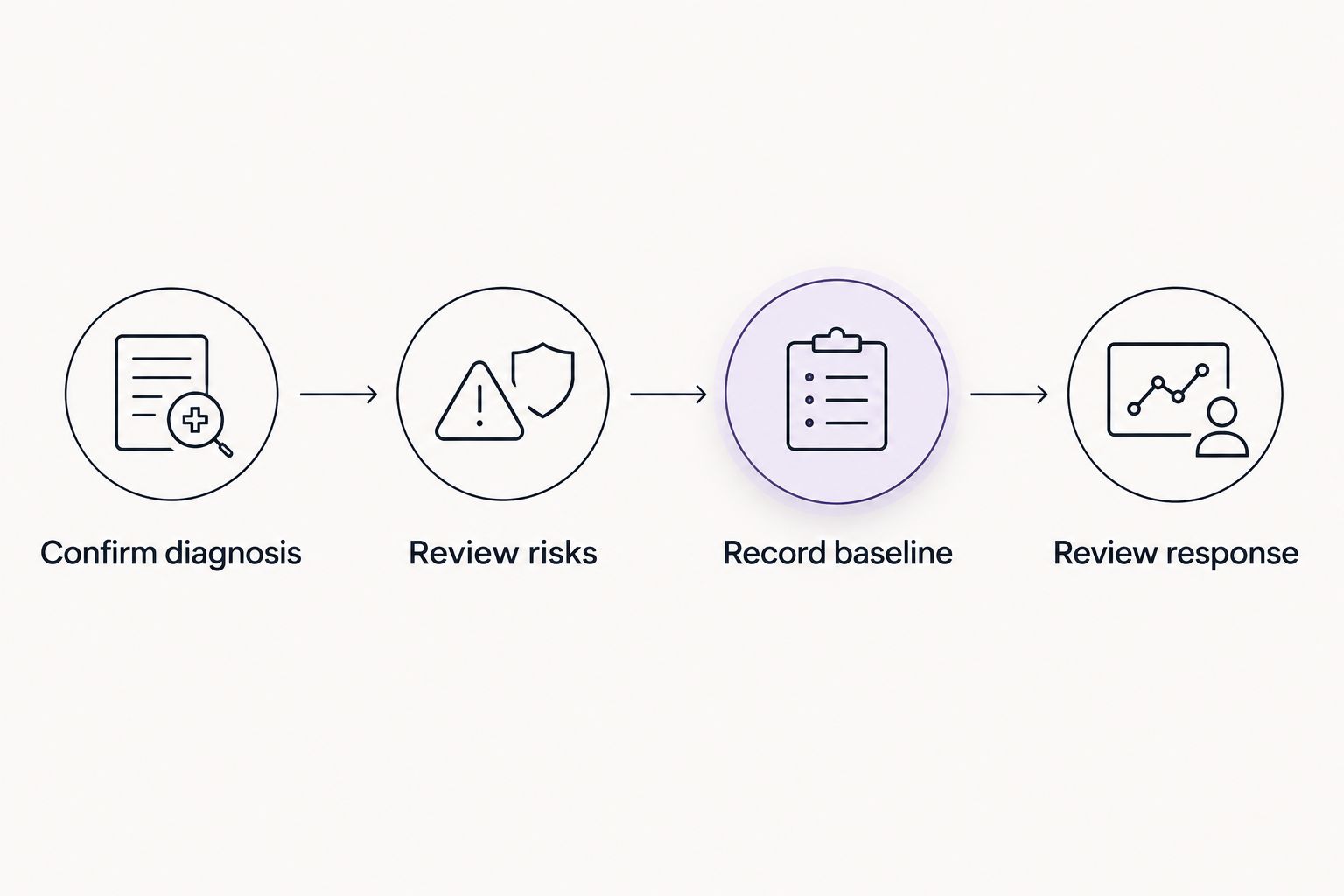
For a plan started in 2026, expect assessment over months rather than days. Clinicians commonly judge medication response over 6–12 months, depending on the treatment and clinical situation. Follow product-specific instructions about earlier review, and report adverse effects promptly.
Directcare offers access to licensed clinicians for hair loss treatment. Bring your timeline and medication list so the conversation starts with your situation, not a product preference.
Discuss your hair regrowth options
Connect with a licensed clinician to discuss hair loss treatment.
Which hair loss treatment should you choose?
For confirmed male pattern hair loss, discuss finasteride plus topical minoxidil as the default combined approach. Choose topical minoxidil when a nonprescription routine fits better; discuss finasteride alone when DHT-focused treatment is the priority.
Oral minoxidil needs a separate risk discussion. Hair transplantation needs surgical planning, and laser devices need product-specific scrutiny. None replaces identifying why your hair is falling out.
FAQ
What's the best hair loss treatment for men in 2026?
For suitable men with confirmed male pattern hair loss, finasteride plus topical minoxidil is a strong combined approach. The best individual choice depends on medical history, adverse-effect concerns, and the routine you can maintain.
Is finasteride better than minoxidil?
Finasteride and minoxidil address different mechanisms, so neither is universally better. Finasteride lowers DHT, while minoxidil supports hair growth without targeting DHT.
How long do hair loss treatments take to work?
Hair loss treatments require months, not days, to assess. Clinicians commonly evaluate medication response over 6–12 months, with earlier review for adverse effects or product-specific instructions.
Is oral minoxidil approved for hair loss?
Oral minoxidil is not FDA-approved for hair loss; prescribing it for that purpose is off-label. A clinician must assess cardiovascular risks and decide whether monitoring is needed.
Do I have to keep using minoxidil?
Continued minoxidil use is generally necessary to maintain treatment-supported growth. Stopping treatment can lead to losing the hair gained or maintained through treatment.
Do hair transplants stop future hair loss?
Hair transplantation does not stop male pattern hair loss in surrounding untreated follicles. Surgical planning should account for future thinning and the limited donor supply.
Should I take supplements for thinning hair?
Supplements are not a substitute for diagnosing hair loss. Correcting an identified deficiency is different from taking a general hair supplement without evidence that you need it.
When should I see a dermatologist instead of choosing a product?
Seek an examination for sudden or patchy loss, scalp pain, significant redness, scaling, or signs of scarring. These findings can indicate conditions that need treatment different from routine male pattern hair loss.
One last thing
Stable hair can be a treatment success. Male pattern hair loss is progressive, so holding your baseline matters even when dramatic regrowth does not appear. Compare consistent photographs—not your memory of yesterday's hairline.