
Hims makes online men's health care approachable, particularly for concerns such as hair loss and sexual health. That convenience does not replace the separate clinical work needed to diagnose low testosterone and decide whether TRT is appropriate. The best Hims TRT alternative in 2026 is Directcare if you need a telehealth TRT evaluation; an endocrinologist is the better fit if the cause of low testosterone needs specialist investigation.
- Compare Hims TRT alternatives by diagnosis, fertility planning, and follow-up—not testosterone prescriptions alone.
- Directcare offers telehealth access to licensed clinicians for TRT and blood lab testing.
- An endocrinologist fits complex hormone questions; a urologist fits fertility and reproductive concerns.
- TRT requires symptoms, confirmed low testosterone, and a plan to monitor treatment safely.
Why this matters
Low energy, reduced sex drive, and erectile difficulties do not point to one diagnosis. Sleep problems, medication effects, depression, thyroid disease, and other conditions can produce overlapping symptoms. Choosing a testosterone provider before understanding the cause puts the treatment ahead of the diagnosis.
For your 2026 decision, compare the clinical pathway rather than the ease of signing up. You need someone who can interpret symptoms alongside properly timed blood tests, discuss fertility, and explain what happens if treatment does not help. A prescription is only one part of that relationship.
This guide compares care routes, not just websites. It is educational information, not a diagnosis or a recommendation to start, stop, or change hormone treatment.
Hims TRT alternatives at a glance
The right alternative depends on what you need assessed. An online evaluation, a hormone specialist, and a fertility-focused consultation solve different problems; none should be treated as an automatic route to testosterone.
| Option | Best for | Defining strength | Difference from choosing Hims |
|---|---|---|---|
| Hims | People who prefer an online men's health starting point | Familiar telehealth route for men's health concerns | Benchmark its current testosterone pathway against your clinical needs |
| Directcare | People seeking a telehealth TRT evaluation | Licensed-clinician access across TRT and blood lab testing | An alternative platform to assess for testosterone-focused care |
| Endocrinologist | Unclear or complex hormone findings | Investigation of hormonal causes | Choose a specialty rather than a particular online platform |
| Urologist | Low testosterone alongside fertility or reproductive concerns | Male reproductive and urinary expertise | Organize care around reproductive goals and related symptoms |
| Primary care clinician | Symptoms that need a broad initial assessment | Evaluation across several possible causes | Start with your overall health rather than a testosterone-first pathway |
For 2026, the strongest comparison question is: who will explain the diagnosis and remain responsible for follow-up? Confirm the current scope of any service before choosing it. A provider's name alone does not establish what your care will include.
1. Directcare: best for a telehealth TRT evaluation
Directcare connects US patients with licensed clinicians for TRT and other prescribed treatments, with blood lab testing among its services. This makes it a relevant alternative when you want to begin a testosterone discussion through telehealth. Treatment still depends on a clinician's assessment, not your preference for a particular medication.
Best for: You want an online clinical starting point and are prepared to complete the testing and follow-up your clinician recommends.
Where Directcare shines
- Relevant scope: TRT and blood lab testing are explicitly part of the platform's services.
- Clinician involvement: The model connects patients with licensed clinicians rather than treating a symptom questionnaire as a diagnosis.
- Broader care categories: Its stated services also include weight loss, sexual health, and other treatment areas. Tell your clinician about every medication and supplement you use.
Where this route falls short
- A remote appointment does not replace a hands-on examination when your symptoms require one.
- Access to blood testing does not make every abnormal result suitable for treatment online.
- A telehealth platform is not a substitute for reproductive or endocrine specialist care when the clinical question requires that expertise.
Before proceeding, ask who orders repeat testing, who reviews results, and how medication adjustments are handled. Ask what triggers referral for an examination or specialist consultation. Those answers tell you more about the care relationship than a short intake form does.
Verdict: Hold any treatment decision until the clinician explains the diagnosis, monitoring plan, and implications for fertility.
2. Endocrinologist: best for complex hormone questions
An endocrinologist specializes in hormone-related conditions. This route fits when low testosterone is accompanied by other abnormal hormone results, when the cause is unclear, or when symptoms and test results do not line up.
The goal is not simply to confirm that testosterone is low. It is to establish why it is low and whether another condition needs attention before testosterone treatment is considered.
Best for: You need a cause-focused assessment rather than a straightforward discussion about replacing testosterone.
Where an endocrinologist shines
- Hormone interpretation: Testosterone can be assessed alongside signals from the pituitary and other endocrine systems.
- Diagnostic complexity: A specialist can investigate findings that do not fit a simple pattern.
- Treatment selection: The assessment can address whether TRT is appropriate or whether the underlying condition calls for another approach.
Where this route falls short
- A focused specialist consultation does not replace general preventive care.
- Endocrine expertise is not the same as dedicated male fertility expertise; reproductive goals can require additional input.
- You still need clear agreement about which clinician manages prescriptions, routine monitoring, and other health conditions.
Ask whether the consultation is intended to establish a diagnosis, manage long-term treatment, or both. If several clinicians are involved, identify the person responsible for reviewing each result. Shared care needs explicit responsibilities.
Verdict: Hold TRT initiation until unexplained hormone findings have been assessed.
3. Urologist: best for fertility and reproductive concerns
A urologist is a relevant alternative when low testosterone overlaps with erectile problems, testicular concerns, urinary symptoms, or fertility goals. For fertility-specific care, look for a urologist with male reproductive expertise.
Best for: You want testosterone decisions considered alongside sperm production and reproductive health.
Where a urologist shines
- Can assess reproductive and urinary concerns together.
- Can examine testicular findings that cannot be evaluated fully through a questionnaire.
- Can discuss why testosterone replacement and fertility treatment are not interchangeable.
Where this route falls short
- Not every urology practice focuses on male infertility or hormone management.
- A reproductive assessment does not replace investigation of broader endocrine disease when indicated.
Tell the clinician about future pregnancy plans before discussing prescriptions. External testosterone can suppress sperm production, so a desire to conceive changes the treatment conversation. Do not assume that stopping treatment later will restore fertility on your preferred schedule.
Verdict: Hold testosterone treatment until fertility goals are explicitly addressed.
4. Primary care clinician: best for a broad first assessment
Primary care is a practical starting point when fatigue, sexual symptoms, or changes in mood have not been evaluated. The advantage is breadth: testosterone is considered alongside sleep, medications, mental health, and other possible explanations.
Best for: You have symptoms but do not yet know whether testosterone is the problem.
Where primary care shines
- Reviews your overall health rather than isolating one hormone.
- Can arrange initial testing and identify reasons for specialist referral.
- Can connect the testosterone discussion with existing conditions and medications.
Where this route falls short
- Not every primary care clinician manages TRT.
- Complex hormone findings or fertility concerns can still require specialist care.
Bring your medication list, previous results, and a clear description of what changed. Explain whether symptoms affect sex drive, erections, sleep, concentration, or exercise tolerance; those are not interchangeable complaints.
Verdict: Hold a testosterone-first approach until common alternative causes have been assessed.
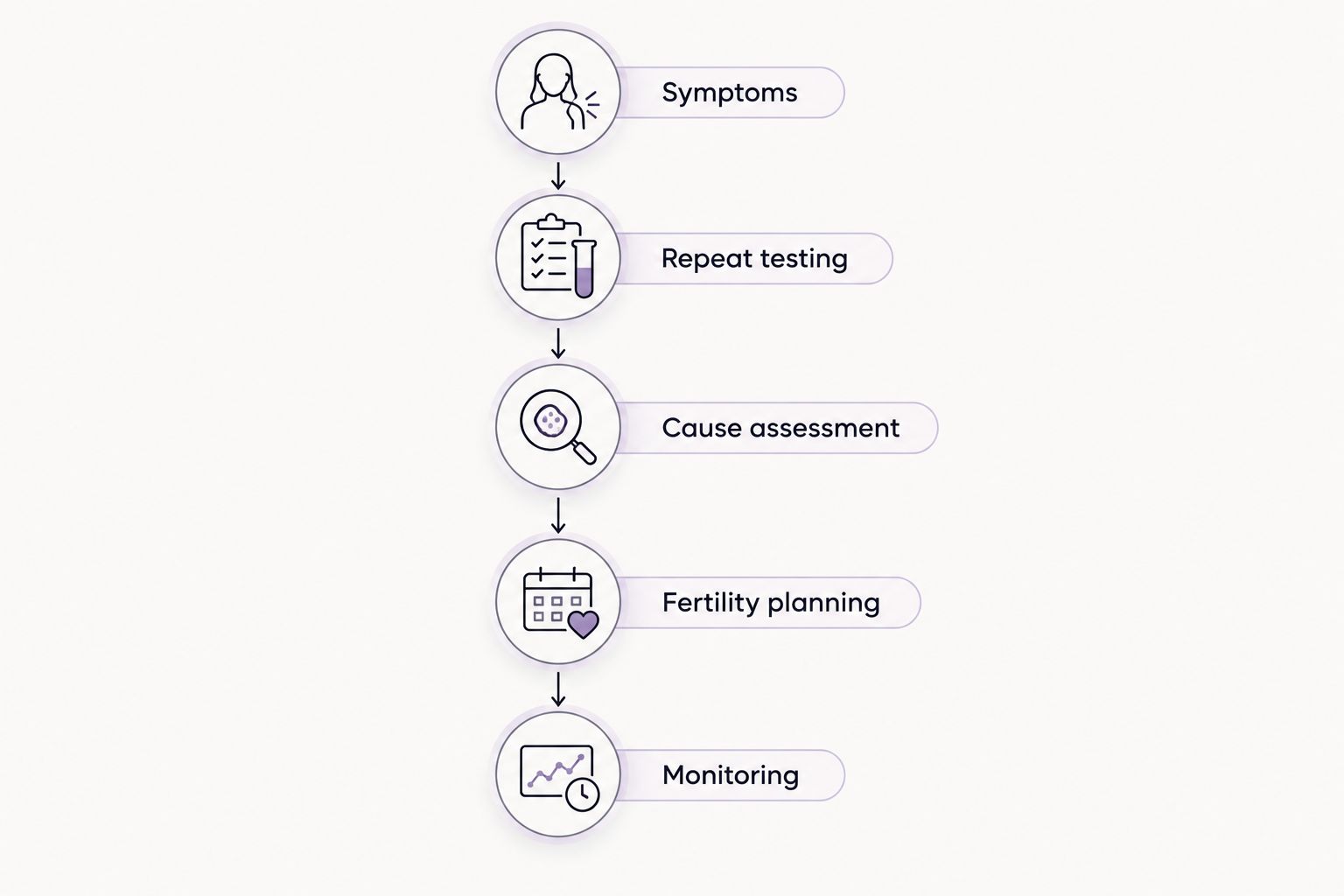
What a sound TRT evaluation should establish
A good evaluation answers a sequence of clinical questions. It should not jump from feeling tired to choosing a testosterone formulation.
Symptoms
Describe the symptoms that prompted testing, when they began, and what else changed around that time. A laboratory result without relevant symptoms does not establish the same clinical picture as persistent symptoms with repeatedly low results.
Repeat testing
The American Urological Association's testosterone-deficiency guideline calls for 2 separate early-morning total testosterone tests when establishing the diagnosis. Its diagnostic framework uses 300 ng/dL as a reasonable cutoff supporting low testosterone, alongside symptoms and signs.
That threshold is not a self-prescribing rule. Your clinician must account for the testing context and decide whether additional measurements, such as free testosterone, are needed. Illness and disrupted sleep can also affect interpretation.
Cause assessment
Ask whether the results suggest a problem with testosterone production or with the hormonal signals that regulate it. Depending on your history and results, clinicians can use additional hormone tests to investigate the cause. Not every patient needs the same panel.
Fertility planning
State whether pregnancy is a current or future goal before treatment is selected. Do not treat fertility as a side-effect discussion to revisit after starting testosterone. It belongs in the initial decision.
Monitoring
Agree on what will be checked, when results will be reviewed, and who will contact you about a concerning finding. Monitoring should address both whether symptoms improve and whether treatment creates a safety problem.
Blood counts are part of this safety discussion because testosterone can increase red blood cell production. The Endocrine Society's testosterone-treatment guideline identifies hematocrit above 54% as a reason for clinician-directed interruption and evaluation. Do not change your dose yourself in response to a result.
A normal-looking testosterone number is not the only treatment goal. Ask how your clinician will judge symptom benefit, adverse effects, and whether continuing treatment remains appropriate.
Why people switch from Hims
A useful reason to switch in 2026 is a mismatch between the care you need and the pathway you have—not an assumption that another brand automatically provides better medicine. These are clinical reasons to consider a different route, not claims about failures at Hims.
- You need a cause explained. An unclear hormone pattern calls for diagnostic work, not simply another prescription request.
- You want to conceive. A reproductive specialist can address sperm production before testosterone replacement is considered.
- You need an examination. Testicular changes or other physical findings require appropriate in-person assessment.
- Your symptoms persist. Ongoing fatigue or sexual symptoms deserve reassessment rather than automatic dose escalation.
- Your care needs coordination. Several prescribers should know about each other's medications and test results.
Before changing providers, request your laboratory reports and medication history. Share the formulation, dose, and timing of your last treatment with the next clinician. Testing while taking testosterone answers different questions from testing before treatment, so the new clinician needs that context.
Do not interrupt prescribed treatment solely to produce a different laboratory result. Arrange the transition with a clinician and clarify who remains responsible during the handover.
When staying with Hims is the right call
Staying is reasonable if your existing care addresses the problem you actually have, explains the assessment clearly, and provides appropriate follow-up. Switching brands does not itself improve a diagnosis.
For a 2026 testosterone discussion, check the current service directly. Ask whether your concern is within its scope and what happens if you need specialist investigation or an examination. Stay for a suitable care relationship, not simply because your account is already set up.
If you are receiving care for a different concern, keep those decisions separate. Hair loss, erectile dysfunction, and low testosterone can overlap, but treatment for one does not establish the diagnosis of another.
FAQ
What's the best Hims TRT alternative in 2026?
Directcare is a relevant alternative if you want a telehealth TRT evaluation with a licensed clinician. An endocrinologist fits complex hormone questions, while a urologist with reproductive expertise fits fertility concerns.
Is Hims the same as a testosterone clinic?
An online men's health platform is not automatically equivalent to a testosterone-focused clinical service. Confirm Hims' current scope and ask what diagnostic testing, prescribing, monitoring, and referral arrangements apply to your situation.
How many testosterone tests do I need before TRT?
The American Urological Association recommends 2 separate early-morning total testosterone measurements when establishing testosterone deficiency. Your clinician also needs compatible symptoms and may order additional tests to interpret the results.
Does testosterone below 300 ng/dL mean I need TRT?
No, a result below 300 ng/dL does not automatically mean you need TRT. The American Urological Association uses that threshold to support diagnosis alongside symptoms and repeat testing; treatment requires an individual clinical assessment.
Can TRT affect my ability to have children?
Yes, external testosterone can suppress sperm production. Tell your clinician about current and future fertility goals before starting treatment, and seek reproductive expertise when needed.
Should I choose an endocrinologist or a urologist?
Choose an endocrinologist for complex hormonal causes and a urologist with male reproductive expertise for fertility-focused concerns. Some patients need both, particularly when abnormal hormone findings overlap with reproductive goals.
Can I switch testosterone providers without stopping treatment?
Plan the transition with your current and next clinician rather than stopping or continuing on your own. Share your treatment details and laboratory reports so responsibility for prescribing and monitoring stays clear.
One last thing
Before comparing providers, write down your fertility plans—even if having children feels distant. Testosterone replacement can improve appropriately selected patients' symptoms while suppressing sperm production. Those outcomes can happen together.
For your 2026 decision, bring three things to the consultation: your symptoms, your complete medication list, and your reproductive goals. A useful plan explains what the results mean in plain English, why treatment is or is not appropriate, and what happens next.